
Why Is My Balance Worse in the Dark?
If you feel less steady walking through a dark room, getting up at night or walking outside after sunset, there is a physiological reason for it. Balance often becomes more difficult in the dark because your brain loses some of the visual information it normally uses to determine where your body is in space.
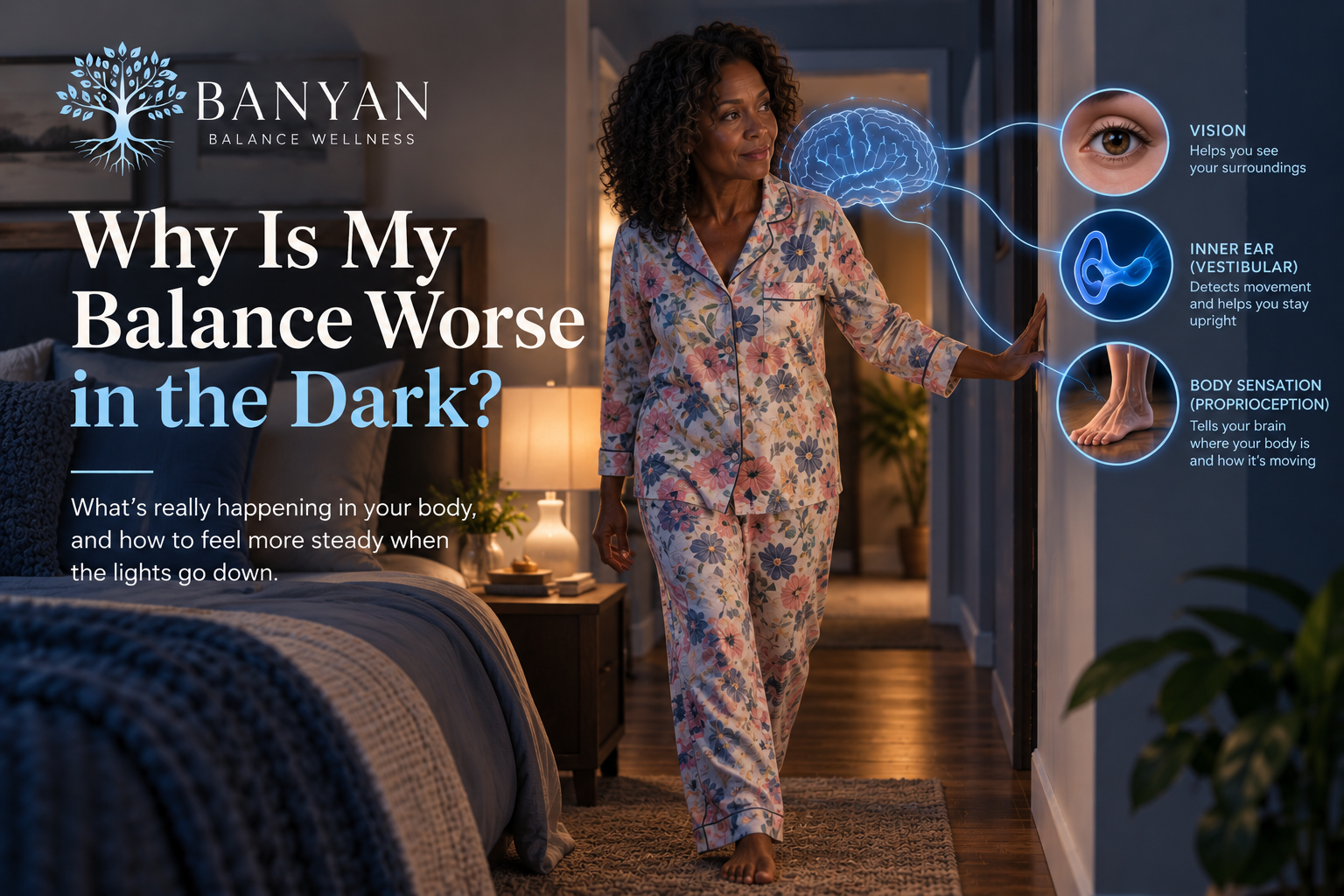
Your balance system relies primarily on information from three sources: vision, the vestibular system in the inner ear, and somatosensory information from your muscles, joints, skin and feet. Your brain continually combines these signals to keep you upright and help you move safely.
When the lights go down, one of those information sources becomes less reliable. Your nervous system has to depend more heavily on the others.
This is why I find balance in the dark such an interesting subject. It isn't simply about whether you can walk confidently through a dark bedroom. It gives us a window into how your nervous system is solving the problem of balance in the first place.
Why do I lose my balance in the dark?
You may lose your balance more easily in the dark because your brain has less visual information available to help determine your body's position and movement. It must compensate by relying more heavily on your inner ear and the sensory information coming from your body.
During the day, your eyes are constantly providing reference points. You can see the floor, walls, horizon, furniture, steps and changes in the surface ahead of you. Your brain uses all of that information alongside signals from your inner ear and body.
In darkness, those visual references are reduced. The brain responds by changing how much importance it gives to the remaining sensory information, a process known as sensory reweighting.
We do this constantly without being aware of it. If you step from a firm sidewalk onto soft grass, the information coming through your feet changes and your nervous system adjusts. If you enter a dark room, the reliability of your visual information changes and another adjustment has to occur.
So feeling somewhat less steady in darkness doesn't automatically mean that something is wrong. You have made the balance task more difficult by removing information that your brain normally uses.
The more interesting question is how much your balance changes when that information is removed.
Why is it harder to balance with my eyes closed?
It is harder to balance with your eyes closed because vision is one of the major sensory systems your brain uses for postural control. Without vision, your brain must rely more heavily on vestibular information from the inner ear and somatosensory information from the rest of the body.
This is also why most people sway more when they close their eyes. Small amounts of postural sway are normal. Even when we think we are standing still, the body is continually making tiny adjustments to keep our center of mass over our base of support.
Closing your eyes doesn't create those adjustments. It simply makes the job of organizing them more demanding.
This distinction matters because standing with your eyes closed is sometimes treated as though it were simply a test of "good" or "bad" balance. I don't find that particularly useful. What interests me much more is the difference between the two conditions.
What happens when you close your eyes? Does your sway increase slightly? Do your feet suddenly grip the floor? Does your whole body become rigid? Do you immediately reach for something?
Those changes tell us something about how much your balance strategy may depend on vision.
Does vision affect balance?
Yes. Vision plays an important role in balance by giving the brain information about your surroundings, your orientation and your movement relative to the environment. When visual information becomes limited or unreliable, maintaining balance generally becomes more challenging.
We tend to think of our eyes as showing us where to go, but vision is also helping us understand where we are.
Imagine standing inside a room. The vertical lines of a doorway, the floor beneath you and the position of objects around you all provide visual references. Outdoors, the horizon and surrounding environment provide additional information.
Vision also allows us to anticipate what is coming. If I can see a curb several steps ahead, my nervous system can begin preparing for it before I reach it. If I cannot see the curb clearly, I lose some of that ability to prepare.
This is one reason low light can affect walking differently from simply standing still. Balance isn't only about responding to movement after it happens. It is also about anticipating the movement that is about to be required.
What does the inner ear have to do with balance?
The vestibular system in your inner ear helps your brain detect head movement, acceleration and your orientation relative to gravity. It works together with vision and body sensation to maintain balance and stabilize you while you move.
You use this system constantly, although you are usually unaware of it. Turn your head while walking, look upward, bend down, change direction or get out of bed, and vestibular information helps your brain understand what your head is doing while the rest of your body organizes around it.
When vision is reduced, vestibular information becomes particularly important because the brain has fewer visual references available.
This can also explain why some vestibular problems become much more noticeable at night. During the day, a person may be using vision very effectively to compensate for less reliable vestibular information. Reduce that visual input and the compensation becomes less effective.
The darkness didn't necessarily create the balance problem. It may simply have made an existing weakness easier to notice.
What is proprioception and how does it affect balance?
Proprioception is your body's ability to sense its position and movement without having to look. It contributes to balance by telling your brain where your joints and body parts are and how they are moving.
Close your eyes and bend your elbow. You know that it moved even though you didn't watch it happen. That awareness comes from sensory information generated within the body.
For balance, the information coming from the feet and ankles is especially important. Pressure against the floor, changes in weight distribution and movement at the ankle all provide information that helps the nervous system understand what is happening underneath you.
If your weight begins moving forward, for example, your nervous system doesn't need to wait until you consciously think, I appear to be falling forward. Sensory information is already being processed and corrective muscular activity can begin.
This is also why strength alone doesn't explain balance. You certainly need enough muscular capacity to respond, but your nervous system also needs reliable information about where the body is and what it is doing.
Balance is both a movement problem and an information problem.
Why is walking in the dark harder than standing still?
Walking in the dark is harder because walking continually changes your base of support while reduced visibility makes it more difficult to anticipate where and how your next foot will land.
Standing with two feet on the ground gives your nervous system a relatively predictable problem. Walking does not. Your weight shifts from one leg to the other, one foot repeatedly leaves the floor, your center of mass moves forward and the next foot has to establish a new base of support.
Vision normally helps enormously with this process. You see the next step, the edge of a curb, a change in pavement, an object in your path or a slope in the ground and begin adapting before you reach it.
In darkness, some of that advance information disappears.
This is why walking through your own dark bedroom may be relatively manageable while navigating an unfamiliar dark room can feel completely different. In your bedroom, your brain has another useful resource: memory. You already have a reasonable idea of where the bed, doorway and furniture are.
Put the same person in an unfamiliar environment and there is much more uncertainty for the nervous system to solve.
Why does my balance get worse at night as I get older?
Balance in low light may become more difficult with age because vision, vestibular function, proprioception, strength and reaction time can all change over time. Reduced vision at night can make the brain more dependent on sensory systems that may themselves have changed.
This does not mean that losing your balance is simply an inevitable part of getting older.
That distinction is important to me.
There are many ingredients involved in balance, and they do not all change at the same rate or in the same way. One person may have excellent strength but reduced ankle mobility. Another may have good mobility but depend heavily on vision. Someone else may have reduced sensation in the feet or difficulty processing vestibular information.
Confidence also becomes part of the equation. Once people begin to worry about falling, their movement often changes. They may take shorter steps, stiffen the body, look continuously at the ground or avoid situations that make them feel uncertain.
Fear and balance can therefore begin influencing one another.
Instead of asking only, "Is my balance worse because I'm getting older?" I think the more useful question is, "Which parts of my balance system are changing, and which of them can we work on?"
Very often, there is quite a lot we can work on.
Is it normal to feel unsteady in the dark?
Some increase in unsteadiness in darkness is normal because removing clear visual information makes balance more difficult. However, severe, new or progressively worsening instability in the dark should not automatically be dismissed as normal aging.
If you find yourself regularly holding walls or furniture to move through a dark room, experiencing repeated near-falls or falls, or noticing significant dizziness, vertigo or a sudden change in your balance, it is worth discussing this with an appropriate healthcare professional.
Balance problems have many possible causes. Vision, vestibular function, neurological conditions, sensation, medications, strength and other medical factors can all play a role.
The useful question isn't simply whether you are "good at balance." It is why your balance behaves the way it does under different conditions.
That is something we can investigate.
Can you improve your balance in the dark?
Yes. Balance can often be improved through training that safely challenges the visual, vestibular and proprioceptive systems and teaches the nervous system to adapt to changing sensory information.
But training balance with less vision doesn't mean wandering around your house in darkness.
It also doesn't mean that the fastest route to better balance is closing your eyes and standing on one foot.
Effective balance training is progressive. We can change the amount of visual information available while keeping the surface and foot position predictable. Later, we might change another variable. The nervous system is given a problem that is challenging enough to require adaptation but safe enough to solve successfully.
That is a very different philosophy from making an exercise as difficult as possible.
I don't want you to prove how long you can avoid falling.
I want your nervous system to get better at finding you.
Elena's Homework: Teach Your Balance System to Notice the Difference
For this week's homework, we're going to change one thing only: visual information.
Choose a firm, level floor and stand beside a sturdy kitchen counter or another fixed support you can reach immediately. Keep your feet approximately hip-width apart. If you have significant balance difficulties, dizziness, a history of falls or have been advised not to perform unsupported balance exercises, please do this only with guidance from an appropriate professional.
Begin in normal lighting with your eyes open. Stand comfortably for 20 seconds and pay attention to what you feel through your feet and ankles. Notice where your weight is distributed and whether your body makes small adjustments. Don't try to eliminate them. Those corrections are part of normal balance.
Next, repeat the same 20 seconds in dim light, keeping your eyes open. You should still be able to see the room and your support clearly. Keep everything else the same: same foot position, same floor, same posture.
Now compare the two experiences. Did you become more rigid? Did your ankles work differently? Did you begin gripping with your toes? Did you suddenly want the counter closer?
Finally, return to normal lighting and stand in the same safe position beside your support. Close your eyes for three seconds, then open them and reset. Repeat this five times.
Practice this sequence several times during the week. If three seconds with your eyes closed becomes consistently comfortable and controlled, increase it gradually to five seconds. There is no reason to rush beyond that.
The purpose of the exercise isn't to accumulate seconds. It is to let your nervous system experience the same balance task under three different visual conditions and begin becoming more comfortable when vision contributes less information.
And please don't add a cushion, lift one foot, turn your head and close your eyes at the same time. More difficult doesn't automatically mean more effective.
For this exercise, the simplicity is the point.
Good balance isn't the ability to stand perfectly still. It is the ability to use the information available to you, recognize when that information changes, and adapt your movement accordingly.
This week, we're simply giving your nervous system an opportunity to practice doing exactly that.
With mindfulness,
Elena
____________________________________________________________________________________________________________________________________________________________________________________________________________________________
Sources
National Institute on Deafness and Other Communication Disorders (NIDCD), Balance Disorders.
Manchester D, Woollacott M, Zederbauer-Hylton N, Marin O. Visual, Vestibular and Somatosensory Contributions to Balance Control in the Older Adult. Journal of Gerontology.
Osoba MY et al. Balance and Gait in the Elderly: A Contemporary Review.
Ageing Vision and Falls: A Review.
Measuring Vestibular Contributions to Age-Related Balance Impairment: A Review.
Sensorimotor and Proprioceptive Exercise Programs to Improve Balance in Older Adults: A Systematic Review with Meta-analysis.