
Balance After 50: What Changes, What Doesn’t, and What Can You Train?
Balance is one of those abilities we rarely think about until something about it feels different. Maybe stepping off a curb suddenly requires a little more attention. You notice yourself reaching for the railing on stairs. Walking across wet grass feels less automatic than it used to. Or you try standing on one leg during an exercise class and wonder, When did this get so difficult?
If you are over 50 and have noticed changes in your balance, it does not automatically mean that something is wrong. Balance is not a single ability that simply disappears with age. It is the result of several systems constantly sharing information and making tiny adjustments, and some of those systems do change as we get older.
The encouraging part is that many of the abilities involved in balance remain trainable.
So what actually changes after 50? What remains remarkably adaptable? And what should we be practicing?

What actually creates balance?
We often talk about balance as though it lives somewhere in the legs or the core. In reality, staying upright is a whole-body conversation.
Your brain is continually receiving information from several sources. Your eyes tell you where you are in relation to your surroundings. Your vestibular system in the inner ear helps detect head movement and orientation. Proprioceptors in muscles, tendons and joints provide information about where your body is positioned without requiring you to look at it. Your feet give you information about the surface beneath you.
Then your nervous system has to interpret all of that information and produce an appropriate physical response.
That response might involve your ankles making an adjustment you barely notice, your hip shifting, your trunk rotating, or your foot taking a quick step.
Balance, then, isn't really about remaining perfectly still.
It is about detecting change and responding to it.
Why can balance change as we get older?
There isn't one switch that flips at 50.
Instead, gradual changes can occur across several of the systems involved in balance. Muscle strength may decrease if it isn't maintained. Joint mobility can change. Reaction times may become slower. Vision changes, including depth perception and contrast sensitivity, can make certain environments more challenging. The vestibular and proprioceptive systems can also undergo age-related changes.
None of this happens identically for everyone.
Activity level, health conditions, medications, previous injuries, vision, hearing, strength and even confidence can all influence how steady someone feels.
That is why two people of the same age can have completely different experiences of balance.

Can you improve your balance after 50?
Yes. And perhaps the more useful question is: what part of balance are you trying to improve?
Research supports balance and exercise training in middle-aged and older adults, but balance training is most useful when it challenges the different abilities that contribute to staying upright rather than repeatedly practicing one isolated position.
Standing on one leg may be part of that training. But real life rarely asks us to stand motionless on one foot while staring straight ahead.
Real life asks us to turn around when someone calls our name. Step over a puddle. Walk while carrying groceries. Move through a crowd. Recover when a shoe catches the edge of a rug. Adjust to a sidewalk that slopes unexpectedly.
Those are balance problems too.
And they require adaptability.
Is standing on one leg a good test of balance?
It can tell us something about your ability to maintain a relatively small base of support. Clinicians also use standardized balance assessments that include different standing and movement tasks.
But a single-leg stand is not a complete report card for your balance.
Someone may be able to stand beautifully on one leg in a quiet room and still have difficulty navigating uneven ground, turning quickly, walking in low light or recovering from an unexpected loss of balance.
This distinction matters because testing balance and training balance are not always the same thing.
If every balance session consists of repeatedly testing how long you can hold a difficult position, you may be measuring your ability more often than developing it.
Why is my balance worse when I close my eyes?
Try standing comfortably with your feet apart and notice how little attention the task requires. Now imagine performing the same task with your eyes closed.
You have just removed one of the major sources of information your nervous system uses for postural control.
Vision can become particularly important when information coming from another system is less reliable. Research into postural control has found age-related differences in how sensory information is integrated, which helps explain why darkness or reduced visual information can make balance noticeably more difficult for some older adults.
This is also why autumn and winter can quietly expose balance difficulties that were less obvious during summer.
You may be walking outside more often in dim light. Stairs can be harder to distinguish. Pavement may be wet. Fallen leaves can obscure the surface beneath them.
The body hasn't necessarily become dramatically less capable between August and November. The environment has simply changed the problem it has to solve.
Why is uneven ground so much harder?
A smooth studio floor is wonderfully predictable.
A park path is not.
Every small change in the ground requires your body to gather new sensory information and modify the next movement. Uneven surfaces alter walking mechanics and increase the demands placed on postural control.
That is one reason I like thinking about balance beyond exercises.
A walk through a park in autumn can contain dozens of tiny balance problems: a patch of leaves, a tree root, a slope, soft earth, a curb, a quick change of direction.
Your body is constantly negotiating with the ground.
That negotiation is part of balance.
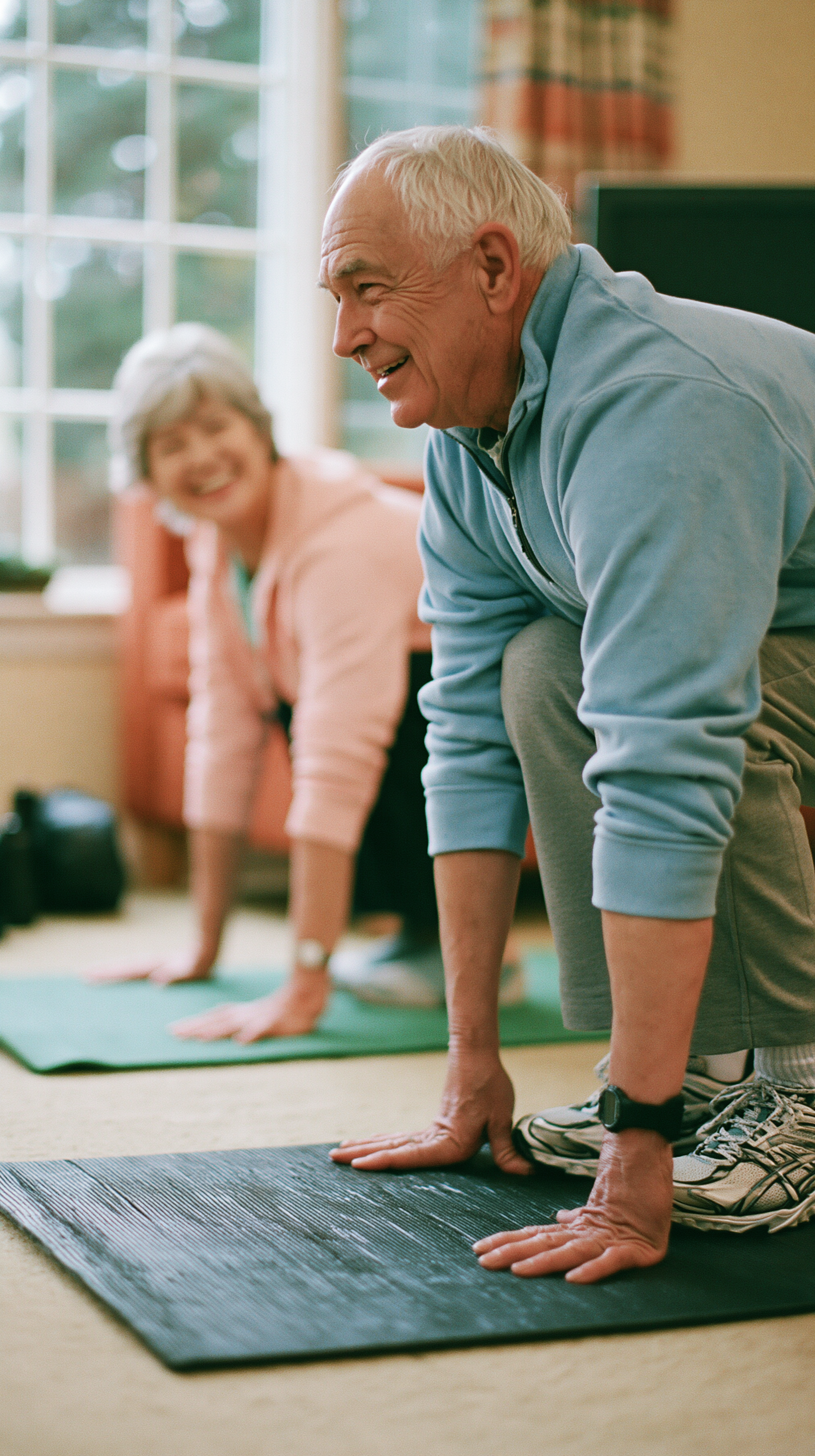
What does strength have to do with balance?
Quite a lot, although strength and balance aren't interchangeable.
If you begin to lose your balance, your body needs enough force to make a useful correction. Sometimes that correction happens around the ankle. Sometimes the hips become involved. Sometimes the safest solution is simply taking another step.
Leg and trunk strength therefore contribute to your ability to respond when your center of mass moves outside your comfortable position.
But becoming stronger alone does not automatically train every component of balance.
You can be strong and still need to work on coordination, sensory awareness, reaction, mobility or confidence in movement.
Think of strength as one member of the balance team, not the entire department.
What is proprioception, and can it be trained?
Proprioception is your ability to sense the position and movement of your body without relying entirely on vision.
Close your eyes and bend your elbow. You don't need to look at your arm to know that it moved.
That internal information is enormously important for balance.
Proprioceptive and sensorimotor exercises can be incorporated into balance training by changing surfaces, positions, visual input or movement demands. Research suggests proprioceptive training can improve measures of balance and sensorimotor function, although programs and outcomes vary considerably.
This is one reason balance practice should sometimes require your nervous system to solve something rather than simply repeat something it already knows.
Can your shoes affect your balance?
They can.
Changing footwear changes the relationship between your feet and the ground. Heel height, sole characteristics, fit and other aspects of footwear can influence gait and stability.
This becomes especially interesting in autumn.
After months of sandals, sneakers and lightweight shoes, suddenly we are wearing boots again. Some are heavier. Some have thicker soles. Some restrict ankle movement. Some simply feel unfamiliar after a summer without them.
Your body has to adapt.
You don't necessarily need a particular type of shoe because you've reached a particular age. But it is worth noticing how different footwear changes the way you walk and how confidently you respond to the ground.
Is losing your balance the same thing as falling?
No, and this may be one of the most important distinctions we can make.
We all lose balance.
Watch someone step unexpectedly onto a moving subway, slip slightly on wet pavement or have a dog suddenly pull on a leash. Their body moves outside its expected position.
What matters next is recovery.
Can you reorganize your body quickly enough? Can you take a step? Can you shift your weight? Can you reach for support? Can you adapt instead of freezing?
This is why I don't think the goal of balance training should be to create a body that never wobbles.
A useful balance program should also help create a body that knows what to do after the wobble.
What can I actually train?
This is where balance becomes much more interesting.
You can work on strength. You can work on ankle and hip mobility. You can challenge proprioception. You can practice changing direction. You can work with different bases of support. You can practice stepping reactions and transitions.
You can also make movement progressively less predictable.
That might mean reaching while standing, turning the head while walking, changing speed, moving around obstacles, carrying something, stepping onto different surfaces or performing a movement while paying attention to something else.
The goal isn't to make every exercise harder for the sake of difficulty.
The goal is to give the nervous system opportunities to notice, organize, respond and recover.

When should balance changes be taken more seriously?
A gradual difference in a challenging balance exercise is very different from suddenly developing unexplained balance problems.
Talk with a healthcare professional if you are experiencing new or persistent dizziness, vertigo, repeated falls, significant unsteadiness, faintness, a sensation that you or the room is moving, or another unexplained change in balance. Balance problems can have many causes, including medical conditions and medications, and exercise is not a substitute for appropriate assessment.
If something has changed noticeably, finding out why comes before deciding how to train it.
Perhaps the better question isn't, “How good is my balance?”
We tend to want a number.
How many seconds can I stand on one leg? How long should I be able to do it at 50, 60 or 70? Am I above average or below it?
Those numbers can sometimes be useful in assessment. But they can also distract us from something more meaningful.
What happens when your environment changes?
Can you move from the floor to standing? Can you turn and continue walking? Can you adjust to an uneven surface? Can you recover from a small stumble? Can your body use different information when one source becomes less reliable?
Aging changes some of the ingredients involved in balance. It does not mean that your nervous system stops learning or that your movement stops adapting.
After 50, perhaps balance deserves less testing and more curiosity.
Because the goal isn't to become perfectly still.
It is to remain capable of finding your way back.
With mindfulness,
Elena