
Can Your Feet and Ankles Affect Your Balance?
When people think about improving balance, they often think first about strengthening their core or practicing standing on one leg. The feet and ankles tend to get much less attention, which is surprising when you consider that they are quite literally where most of us meet the ground.
Your feet are not simply platforms underneath your body, and your ankles are not just hinges that allow you to walk. Together, they provide the nervous system with a remarkable amount of information about pressure, position, movement and the surface beneath you. They also make many of the small muscular adjustments that help keep you upright before you are even aware that your balance has changed.
So if your feet are stiff, your ankles have limited movement, sensation has changed, or the muscles around them are not responding effectively, can that affect your balance?

Very much so.
Can foot problems affect your balance?
Yes. Problems affecting the feet can influence balance because the feet provide both physical support and important sensory information about pressure, body position and the surface beneath you. Pain, reduced sensation, weakness, stiffness or changes in foot mechanics can alter the way you stand and move.
Think about what happens when you step onto something unexpectedly uneven. Your foot detects the change, your ankle responds, and your nervous system begins adjusting the rest of the body. Much of this happens so quickly that you never consciously register the original problem.
The feet are therefore doing two jobs at once. They help support and move the body, but they are also gathering information.
This is one reason foot pain can have effects beyond the painful area itself. If putting weight through one part of the foot hurts, we naturally begin to change how we load it. That may alter the way we stand, the length of our steps, how much time we spend on one leg, or the way weight moves from one side of the body to the other.
Sometimes the body adapts beautifully. Sometimes those adaptations create a new balance challenge somewhere else.
How do your feet help you balance?
Your feet help you balance by creating a stable base of support and sending continuous sensory information to the nervous system about pressure, weight distribution and contact with the ground. Your brain uses this information to make rapid postural adjustments while you stand and move.
If you stand quietly for a moment and pay attention to your feet, you may notice that your weight is not perfectly stationary. It moves slightly forward and backward and from side to side. The pressure under different parts of your feet changes along with it.
Those small shifts provide useful information.
If your weight moves too far toward your toes, the nervous system detects the change and organizes a response. If the ground slopes slightly, your feet and ankles provide information about that too. When you move from a hard floor onto grass, sand or gravel, the sensory picture changes again.
This is part of what makes balance so interesting to me. The brain is not controlling the body from some distant command center while the feet simply obey. Information is traveling in both directions continuously.
Your feet are part of that conversation.
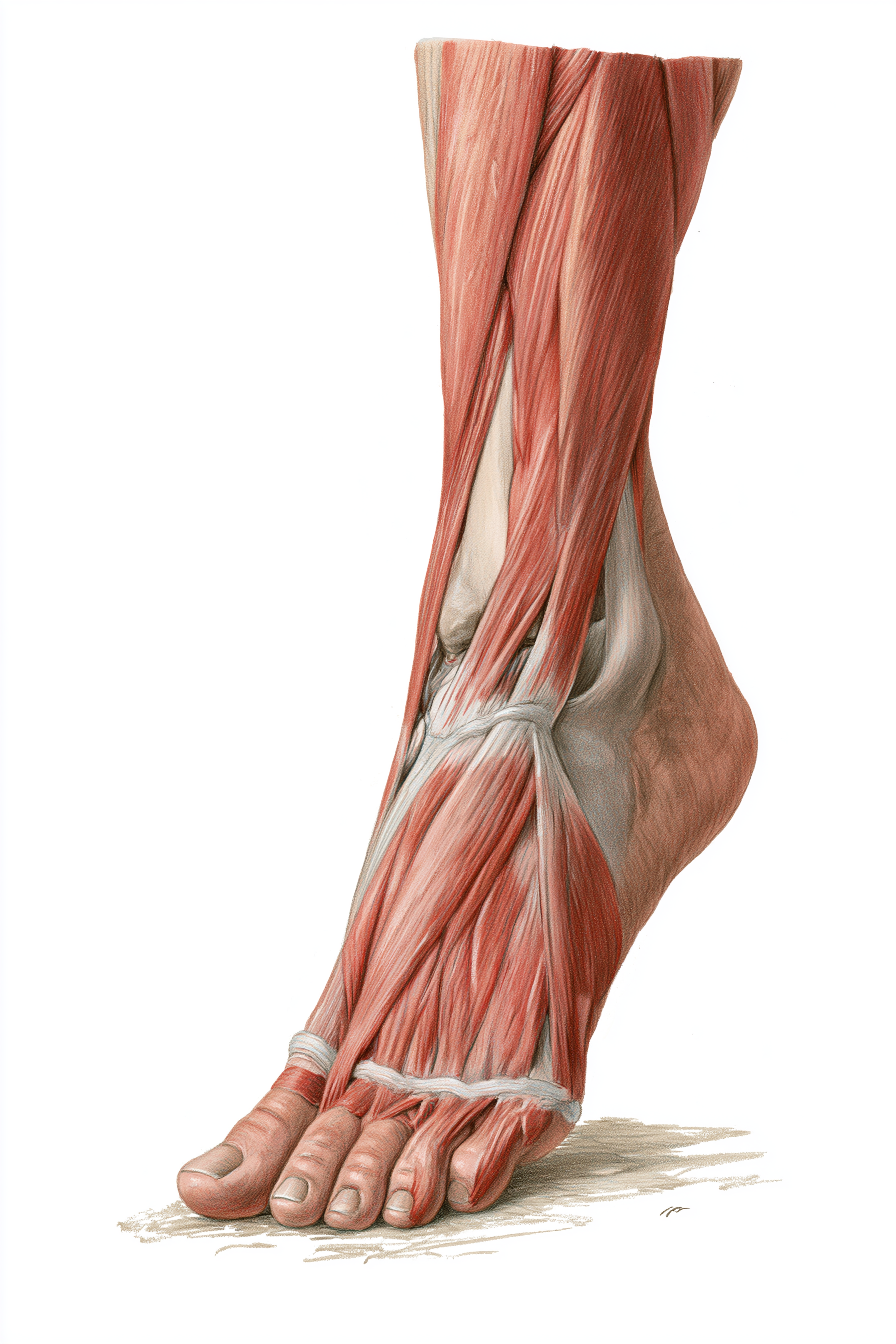
Can weak ankles cause poor balance?
Weakness in the muscles around the ankle can contribute to balance difficulties because those muscles help control body sway, stabilize the ankle and make rapid corrections when your weight shifts. Ankle strength is particularly important when standing, walking and recovering from small disturbances in balance.
Stand quietly and lean your body forward just a tiny amount without lifting your heels. You may feel the muscles around your lower legs and ankles begin to respond. Move gently backward and the muscular demand changes.
These small ankle responses are part of one of the strategies the body uses to maintain upright balance.
The important word here, though, is response.
Having strong ankle muscles is useful, but balance isn't simply a contest to see how much force those muscles can produce. They need to produce the appropriate amount of force at the appropriate moment, based on sensory information arriving at the nervous system.
This is why strengthening can be an important part of balance training without being the whole answer. A stronger ankle that cannot adapt quickly to a changing surface still has a problem to solve.
Can stiff ankles affect balance?
Yes. Limited ankle mobility can affect balance because the ankle needs enough movement to allow the body to shift, adapt to uneven surfaces and keep the center of mass over the feet. Restricted ankle movement can change both standing balance and the way you walk.
One movement that is particularly important is ankle dorsiflexion, the movement that brings the shin forward over the foot.
You use it when you walk, climb stairs, squat, lower yourself toward a chair and move your body forward over your feet. If that movement is restricted, the body still has to accomplish the task, so it often finds another strategy.
Perhaps the foot turns outward. Perhaps the heel lifts earlier. Perhaps the stride changes. Perhaps movement occurs somewhere else in the body to compensate.
This doesn't mean everyone needs extremely flexible ankles. More mobility isn't automatically better. What we need is enough useful movement for the activities we are asking the body to perform, combined with the ability to control that movement.
For balance, both matter.
Why are my ankles less stable as I get older?
Ankle stability can change with age because strength, joint mobility, reaction speed and sensory information from the feet and ankles may all change over time. These changes can make rapid balance corrections more difficult, particularly on uneven or unpredictable surfaces.
There is an important difference between saying that these systems can change with age and saying that unstable ankles are simply an unavoidable part of aging.
They aren't.
Someone who has stopped walking on varied surfaces, rarely moves the ankle through a large range, or has become less physically active may be experiencing changes related not only to age but also to what the body is no longer being asked to do.
This is one reason I like to look at function rather than birthdays.
Can you comfortably move your weight forward over your feet? Can you rise onto your toes? Can you walk over grass? Can your ankle respond when the ground isn't perfectly level? Can you slow yourself down when stepping off a curb?
Those questions tell us much more about what the ankle can actually do.
Does sensation in your feet affect your balance?
Yes. Sensation in the feet plays an important role in balance because it tells the nervous system how your feet are contacting the ground and where pressure is being distributed. Reduced plantar sensation can make it more difficult for the brain to detect changes beneath the feet and organize an appropriate response.
This becomes particularly interesting when we think about balance as an information system.
Imagine wearing very thick gloves and trying to identify a small object with your hands. You may still be able to hold it, but the quality of the sensory information has changed.
Something similar can happen when sensory information from the feet becomes less precise. The feet may still be physically capable of supporting the body, but the brain is receiving a less detailed picture of what is happening at ground level.
This can become even more relevant when another source of balance information is reduced. In the previous article, I talked about what happens when we close our eyes or move through a dark environment. If vision becomes less useful, the nervous system has to depend more heavily on vestibular and somatosensory information.
Our balance systems don't work in isolation. They continually support and compensate for one another.
Can your shoes affect your balance?
Yes. Shoes can affect balance by changing how the foot contacts the ground, how freely the ankle moves and how much sensory information reaches the foot. Fit, sole thickness, cushioning, heel height and shoe structure can all influence stability and walking mechanics.
This doesn't mean there is one universally perfect "balance shoe." What works well depends on the person, the activity and the environment.
But it is worth noticing what happens when your footwear changes.
A thick, highly cushioned sole creates a different sensory experience from a thinner, firmer sole. A loose shoe behaves differently from one that fits securely. A heel changes the position of the foot and ankle. A heavy winter boot changes movement differently from a light sneaker.
I often think this is particularly noticeable during seasonal transitions. We spend months in sandals or lighter shoes and then suddenly return to boots and heavier footwear. Your body hasn't changed overnight, but the relationship between your foot and the ground has.
Paying attention to that difference can tell you quite a lot.
Does walking barefoot improve balance?
Barefoot activity can increase sensory feedback from the soles of the feet and allow the foot and ankle to move differently than they do inside shoes, but walking barefoot is not automatically better or safer for everyone. Whether it is appropriate depends on foot health, sensation, strength, environment and medical history.
This is one of those questions where I resist giving a universal yes or no.
For someone with healthy feet and normal sensation, spending some safe time barefoot may provide a rich sensory experience. You can feel pressure changes and surface textures more directly, and the small muscles of the feet may work differently without the structure of a shoe.
For someone with reduced sensation, certain medical conditions, significant foot pain or a high risk of injury, barefoot walking may be inappropriate.
The goal isn't to declare shoes good and barefoot bad, or vice versa. The useful question is what kind of information and support your feet need for the activity you are doing.
Can ankle exercises improve balance?
Yes. Exercises that improve ankle strength, mobility, control and proprioception can contribute to better balance, particularly when they are combined with broader balance training. The most useful exercises train the ankle not only to produce force, but also to respond to shifts in body weight and changes in the surface beneath you.
This is where I would move beyond simply doing endless ankle circles.
Ankle circles can be perfectly useful for mobility, but everyday balance asks much more from the ankle. We need to shift weight over the foot, control movement forward and backward, push away from the floor, respond to uneven surfaces and make corrections when our center of mass moves.
Good training should gradually reflect those demands.
And, as always, the exercise should match the person. Someone recovering from an ankle injury will have different needs from someone who simply wants to maintain balance as they get older.
What are the best exercises for feet and ankles to improve balance?
The most useful exercises for foot and ankle balance combine sensory awareness, controlled weight shifting, ankle mobility and strength. Rather than training one muscle in isolation, they teach the feet, ankles and nervous system to work together while the body's weight moves over the base of support.
For me, this is the important distinction.
You can strengthen the calf. You can mobilize the ankle. You can work the small muscles of the foot. All of those things may be valuable.
But eventually balance requires integration.
Your foot has to feel what is happening. Your ankle has to move. Your muscles have to respond. Your nervous system has to interpret the information and decide what happens next.
So for this week's homework, I want to put those pieces together.
Elena's Homework: The Foot Compass
For this exercise, we're going to explore how your feet and ankles respond when your body weight moves in different directions.
Stand barefoot or in secure, flat shoes on a firm floor, next to a sturdy kitchen counter or another stable support. If you have significant balance problems, reduced sensation in your feet, an active foot or ankle injury, or a history of falls, do this with appropriate professional guidance rather than experimenting alone.
Place your feet approximately hip-width apart and soften your knees. Before moving anything, notice where you feel pressure underneath each foot. Can you feel your heels? The balls of your feet? The area underneath the big toe and little toe? Is one foot carrying more weight than the other?
Now imagine that the center of your body is the middle of a compass.
Without lifting either foot, slowly shift your whole body a small distance forward. Don't bend from the waist. Let your body travel as one unit and notice the pressure moving toward the front of your feet. Then return to center.
Shift gently backward, keeping the toes on the floor. Notice how the pressure changes toward the heels, then return to center.
Next, move slightly toward the right foot, return to center, and then toward the left foot.
Those are your first four directions: north, south, east and west.
Once those movements feel comfortable, begin exploring the diagonals. Shift slightly forward and right, return to center, then forward and left. Repeat the same idea backward and to each side.
The movement should be small. You are not trying to discover how far you can lean before gravity files a complaint.
Instead, notice what happens underneath you. Where does pressure move? Which direction feels easiest? Does one ankle feel stiffer? Does one foot grip the floor while the other remains relaxed? Can you return to the middle smoothly, or do you overshoot it?
Complete two slow rounds of the compass, pausing briefly at each direction before returning to center.
Then finish by standing quietly for about 20 seconds and noticing your feet again.
Does the floor feel different?
Can you sense the pressure beneath your feet more clearly?
Do you feel more centered?
This deceptively simple exercise combines several things we have discussed: ankle movement, controlled weight transfer, sensory information from the feet and the nervous system's ability to recognize where the body is relative to its base of support.
Practice it once a day for a week. Don't try to make the movement bigger each time. Instead, see whether you can make it clearer, smoother and more controlled.
Because your feet aren't simply the things at the bottom of your body.
They are where your conversation with the ground begins.
With mindfulness,
Elena
————————————————————————————————————————————————————————————————————————————————-
Sources
Menz HB, Morris ME, Lord SR. Foot and Ankle Characteristics Associated With Impaired Balance and Functional Ability in Older People. Journals of Gerontology.
Menz HB, Lord SR. Research on foot problems, plantar sensation, footwear and balance in older adults.
Horak FB. Postural Orientation and Equilibrium: What Do We Need to Know About Neural Control of Balance to Prevent Falls? Age and Ageing.
Henry M, Baudry S. Research examining age-related changes in ankle proprioception and postural control.
Mickle KJ et al. Research examining foot strength and falls in older adults.