
Finding Your Anchor: What Proprioception Has to Do With Feeling Grounded
We use the word grounded rather casually in movement. Put your feet on the floor. Feel your weight. Find your center. Ground yourself.
But being grounded is not simply a matter of having two feet in contact with the earth.
Your brain is constantly trying to answer a surprisingly complicated question: Where am I right now?
Not geographically, of course. It wants to know where your feet are in relation to your hips. Where your shoulders are in relation to your spine. How much weight is traveling through one leg compared with the other. Whether your knee is bending, whether your ankle is adjusting, whether your body is leaning forward, and how much muscular force is needed to keep you from continuing in that direction.
Most of this happens without conscious thought.
This internal sense of position and movement is called proprioception, and it is one of the foundations of balance. It is also one of the reasons I spend time in my Balance Program working on what I call finding your anchor.
Because before we challenge balance, we need to know where we are starting from.
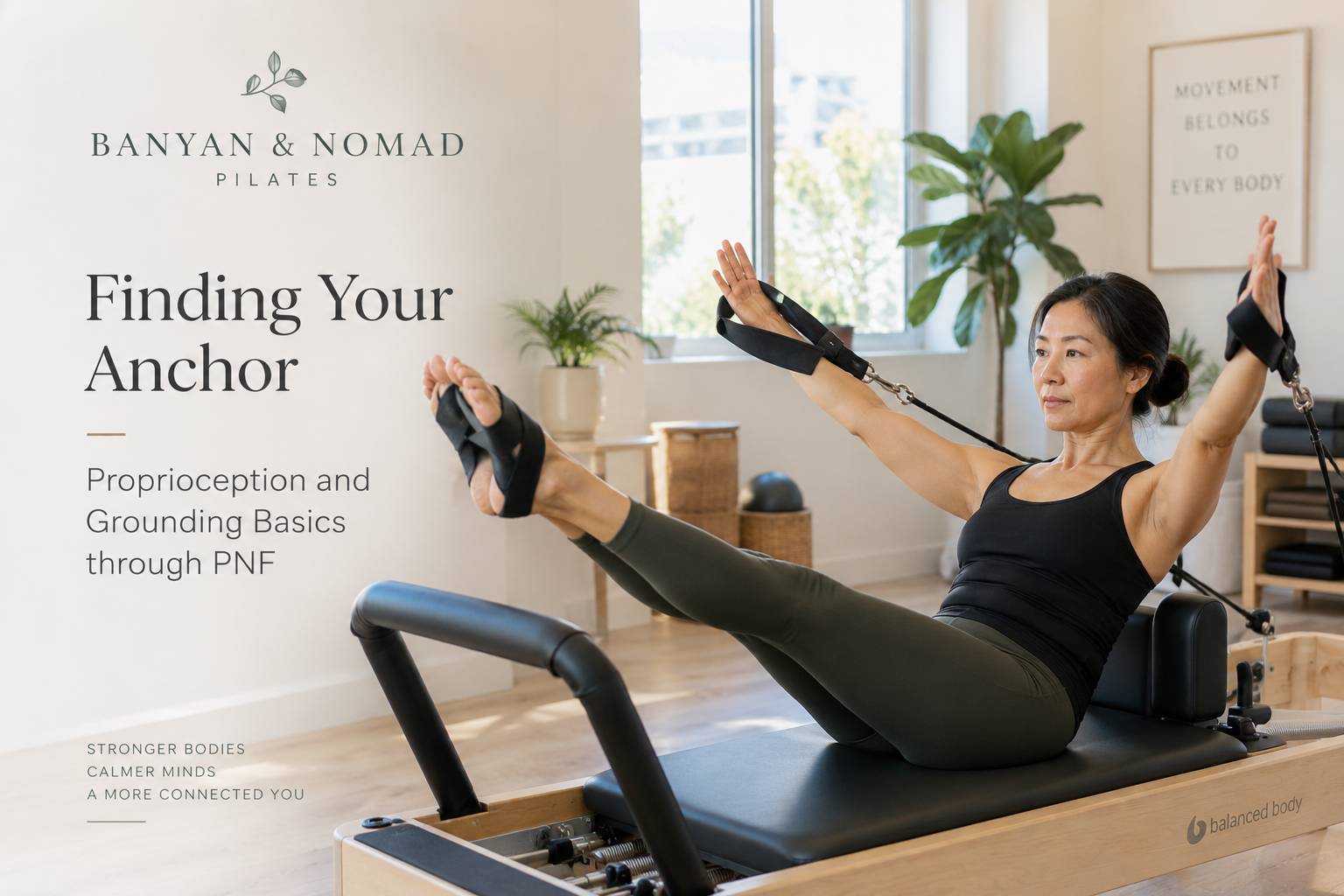
Your Body Has an Internal Map, but It Is Constantly Being Redrawn
Close your eyes and lift one arm overhead.
You probably know where your arm is without looking at it. You know approximately how straight your elbow is, where your hand is in space, and whether your shoulder has crept toward your ear.
That information comes partly from proprioceptors, sensory receptors in muscles, tendons, joints and other tissues that continually send information to the nervous system about position, movement and force.
Your brain combines those signals with information from your eyes and your vestibular system in the inner ear. Together, these systems help create the continuously updated body map you use to stand, walk, turn, reach, climb stairs and catch yourself when something does not go according to plan.
And that last part matters.
Balance is not the ability to remain perfectly still. In daily life, we almost never are. Balance is the ability to know where you are while something is changing and organize an appropriate response.
When you step off a curb that is slightly higher than expected, you don't have time to consciously calculate the position of your ankle, knee, pelvis and trunk. Your nervous system has to recognize what happened and make dozens of tiny adjustments almost immediately.
That ability depends partly on the quality of the information coming in.
This is why someone can have considerable muscular strength and still feel strangely uncertain on one leg, uncomfortable walking over uneven ground or less confident when changing direction quickly. Strength matters, but strength needs information.
Sometimes the problem isn't simply, Can this muscle produce enough force?
The more interesting question is, Does the nervous system know when, where and how much force to use?
Grounding Is Not About Pushing Yourself Into the Floor
When people hear “grounding,” they often respond by becoming rigid.
They push their feet harder into the floor. They tighten their abdomen. They grip their toes. They stiffen their legs as though stability means becoming extremely difficult to move.
But rigidity and stability are not the same thing.
Good balance requires enough stability to support you and enough freedom to respond. Your ankles need to make tiny adjustments. Your hips need to respond. Your trunk needs to organize itself over a changing base of support.
A tree that couldn't move at all in the wind wouldn't necessarily be safer.
I want people to begin noticing the relationship between pressure, position and response. Can you feel where your weight is traveling through your feet? Can you shift your weight without collapsing into one hip? Can you reach away from your center and still know how to return? Can one part of your body move while another provides support?
These are small questions with very practical consequences.
Walking is essentially a repeated transfer of support from one leg to the other. Stairs require you to organize your body over a changing base. Reaching into a high cupboard moves your center of mass. Turning to look behind you changes the relationship between your head, trunk, pelvis and feet.
So when we practice grounding, we aren't practicing standing still beautifully.
We are building a reliable place from which movement can happen.

Why I Use PNF Patterns in Balance Training
One of the tools I use for this in my Balance Program is PNF, or proprioceptive neuromuscular facilitation.
The name sounds considerably more intimidating than the movement needs to be.
PNF originated in rehabilitation and uses coordinated movement patterns that often travel diagonally and rotationally across the body. Rather than isolating a single joint or muscle, these patterns ask several parts of the body to communicate and organize movement together.
That is one reason they interest me for balance.
Human beings don't move through daily life in neat little straight lines. We reach across ourselves to fasten a seat belt. We rotate to pick something up. One arm moves while the opposite leg supports us. We step diagonally around another person. We turn, reach, pull and change direction.
PNF patterns give the nervous system a lot of information at once.
As an arm moves through a diagonal pattern, for example, the shoulder, trunk and pelvis have to respond to that changing position. Add resistance and there is another layer of sensory information. Perform the movement while standing and suddenly the feet and legs have to participate in the conversation too.
This is where PNF becomes particularly useful for the idea of an anchor.
The anchor isn't one body part that refuses to move. It is the organized support that allows movement elsewhere.
When you begin to feel that relationship, balance becomes less about holding on and more about knowing where you are while you move.
That is a very different skill.
The Goal Is Not Better Balance Exercises. It Is Better Responses.
This distinction is important to me because people can become very good at performing a balance exercise without necessarily becoming more adaptable outside the studio.
If you practice standing on one leg in exactly the same position, on exactly the same floor, looking at exactly the same point in front of you, eventually you may become excellent at that particular task.
But life is inconsiderate enough not to reproduce your training conditions.
Someone walks in front of you. The sidewalk tilts. You turn your head when somebody calls your name. You carry a bag in one hand. You step onto grass. You get out of a low chair and immediately start walking. Your foot lands differently than you expected.
This is why I am interested in giving the nervous system problems to solve, rather than simply asking the body to hold positions for longer periods of time.
Proprioceptive work can begin very simply: noticing pressure through the feet, shifting weight, reaching, moving through a PNF pattern, changing direction or reducing visual information. From there, we can gradually alter the challenge.
The point is not to make an exercise harder for the sake of making it harder.
The point is to help the nervous system become better at receiving information, interpreting it and organizing a response.
And something interesting often happens as that process improves. People begin to describe themselves differently.
They don't necessarily say, “My proprioception has improved.”
They say, “I don't have to think about the stairs anymore.”
Or, “I feel steadier when I turn.”
Or, “I caught myself.”
Or simply, “I trust my body more.”
To me, that is where balance training becomes meaningful.
Finding Your Anchor
Your anchor isn't a position you find once and keep.
It changes every time you move.
Sometimes it is both feet underneath you. A moment later, it is one foot while the other steps forward. It might be the relationship between your foot and your hip as you reach, or the way your trunk organizes itself as you turn.
Proprioception helps your nervous system keep track of all of it.
And this is why I like beginning with grounding before asking for increasingly complicated balance challenges. We first give the nervous system a clearer sense of here.
Then we ask it to move somewhere else.
That small distinction can change the way we think about balance altogether. We are not simply training ourselves not to fall.
We are training the body to know where it is, recognize when something has changed, and find its way back.
With mindfulness,
Elena