
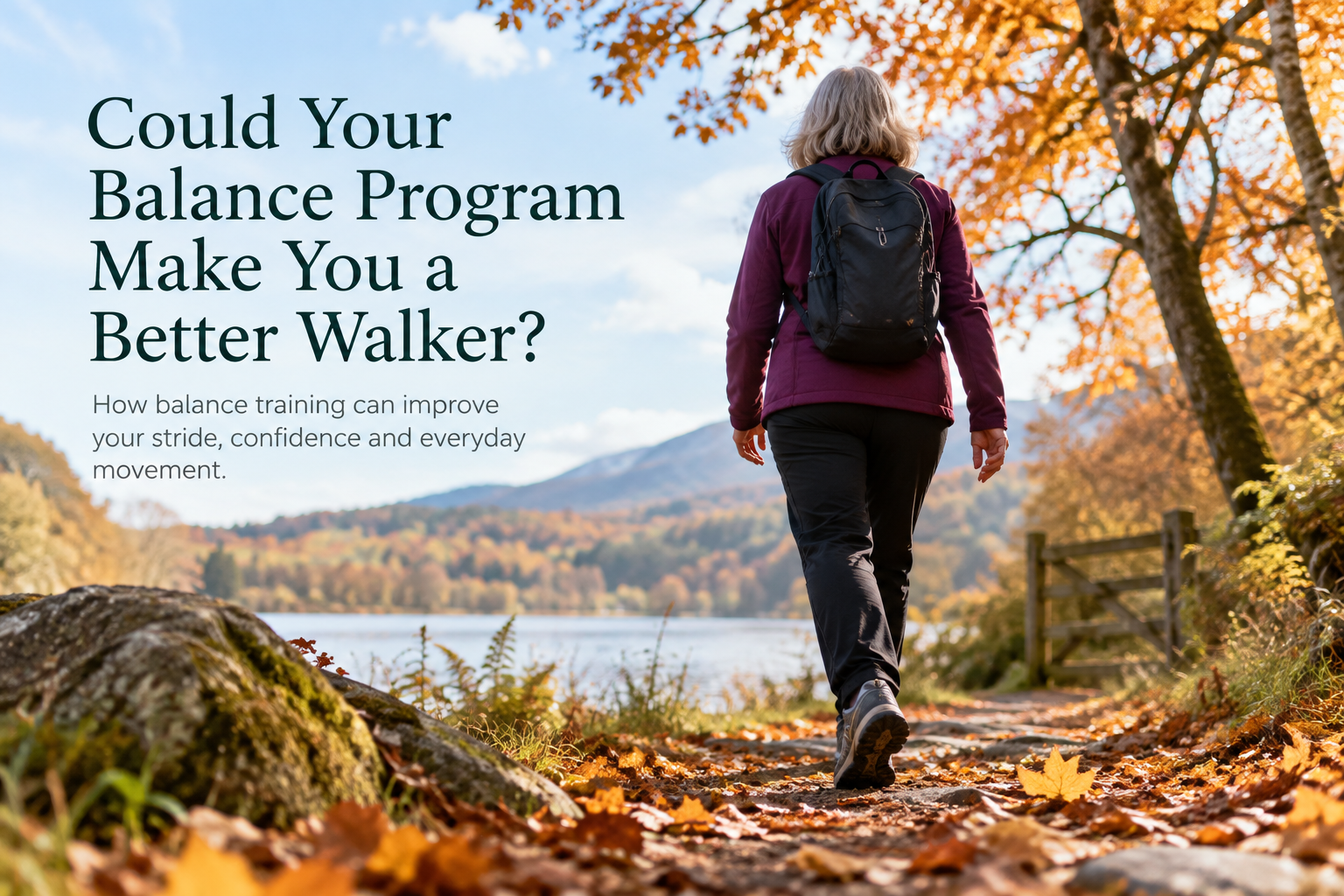
Could Your Balance Program Make You a Better Walker?
Walking is one of those abilities that becomes almost invisible once we learn it. We cross a room while talking, step off a curb while thinking about dinner, change direction when someone appears in front of us, carry groceries from the car and negotiate a cracked sidewalk without consciously planning each movement. Because walking feels automatic, it is easy to think of it as something separate from balance. Walking is walking. Balance is what we practice when we stand on one leg.
The body does not make that distinction. Walking is, in fact, a remarkably complicated balance task. With every step, we deliberately move our center of mass beyond the base supporting us, transfer our weight onto one leg, allow the other leg to travel through space and then create a new base of support before doing it all again. We repeat this controlled instability thousands of times without thinking about it.
That raises an interesting question: if we become better at balance, can we also become better walkers?
Walking Is Balance in Motion
Standing balance gets much of the attention because it is easy to observe and measure. Stand with your feet together. Close your eyes. Stand on one leg. See what happens.
Walking is different. The challenge keeps changing.
During an ordinary walk, information is arriving continuously from the eyes, inner ear, muscles, joints and the pressure receptors beneath the feet. The nervous system uses that information to estimate where the body is, where it is moving and what needs to happen next. Meanwhile, muscles around the ankles, knees, hips and trunk make constant adjustments that are usually far too small for us to notice.
A balance program therefore isn't necessarily training a skill that belongs only in the exercise session. Many of the systems being challenged are the same systems we depend on when we walk.
And that matters because real-world walking is rarely as straightforward as walking ten meters across a flat, empty floor.
The Sidewalk Is Not a Treadmill
Think about what happens during a five-minute walk outside.
You may step from pavement onto grass. Someone approaches from the opposite direction, so you move slightly to one side. There is a puddle ahead. You shorten one step and lengthen the next. You turn your head because you hear a bicycle. The pavement slopes toward the road. A dog appears. You slow down. You step over a broken section of concrete. Then you turn sharply into a doorway.
None of these events seems remarkable. From a balance perspective, however, your nervous system has just dealt with a rapidly changing series of problems involving speed, direction, surface, vision, head position, foot placement and weight transfer.
This is why the quality of walking cannot be reduced simply to leg strength or cardiovascular fitness. Those things certainly matter, but walking also depends on our ability to adapt.
A useful balance program can challenge precisely that adaptability.
Stride Confidence Is More Than Taking Bigger Steps
When people become less confident about their balance, walking can change in subtle ways. Steps may become shorter. The feet may stay closer to the ground. Turning can become slower. A person may widen their stance or spend slightly longer with both feet on the ground. They may hesitate before stepping onto an unfamiliar surface or approaching an obstacle.
Some of these adaptations are sensible. The nervous system is trying to increase security.
The problem arises when cautious movement gradually reduces the variety of movement we experience. If we always choose the safest possible version of a task, the body receives fewer opportunities to practice responding to changing demands.
Balance training can provide those opportunities in a controlled environment.
Rather than simply asking, “How long can I stand without wobbling?” training can introduce changes in stance, weight transfer, direction, visual information, head position, reaching and movement. The goal is not to eliminate movement. It is to become more capable of managing it. That capability can matter once we start walking again.
Turning May Tell Us More Than Straight-Line Walking
We tend to picture walking as forward movement, but everyday life contains an astonishing amount of turning.
We turn around in kitchens. We change direction in stores. We pivot to speak to someone. We navigate furniture, corners, crowds and narrow spaces. We turn before sitting down and often change direction while carrying something.
Turning temporarily reorganizes the walking pattern. The head may begin the movement, followed by the trunk and feet. Step length changes. The base of support changes. The body has to control rotational forces while continuing to remain upright.
That makes turning an excellent example of the relationship between balance and walking.
Someone may feel perfectly comfortable walking along a straight hallway yet become noticeably less certain during a quick change of direction. A balance program that includes controlled weight shifts, multidirectional stepping, rotation and changes in foot position may therefore address abilities that straight-line walking alone does not challenge very much.
The objective isn't to become an expert pivot-er. It is to make changing direction feel like an ordinary part of movement again.
Then Someone Leaves a Bag in the Hallway
Obstacle negotiation reveals another layer of walking. To step over an object, the brain must estimate its position and size, decide where the foot should leave the ground, lift it sufficiently, move the body forward and prepare for the landing. During part of this process, much of the body's weight is supported by the opposite leg.
All of this happens while momentum continues carrying us forward.
We perform similar calculations when stepping over a curb, avoiding a puddle, walking around a fallen branch or navigating the clutter that inevitably appears in real homes.
Balance exercises that develop single-leg control, purposeful weight transfer and accurate stepping can therefore have relevance far beyond the exercise itself.
The exercise is not the destination. It is rehearsal.
Your Eyes Are Helping More Than You Think
Walking also depends on the collaboration of several sensory systems.
Vision tells us about the environment and helps us anticipate what is coming. The vestibular system of the inner ear provides information about head movement and orientation. Proprioceptive information from muscles and joints contributes to our sense of where the body is positioned. Sensory information from the feet tells us something about the surface beneath us.
Normally, these streams of information cooperate beautifully.
But real environments constantly change their reliability. Autumn provides particularly good examples. Fallen leaves can disguise an uneven surface. Earlier evenings reduce visual information. Wet pavement reflects light differently. A woodland path may alternate between firm earth, roots, stones and patches of mud.
The body has to decide which information to trust and adjust accordingly. This is one reason balance exercises can become more useful when they involve more than holding a fixed position. Changing where we look, moving the head, altering the base of support or introducing controlled movements asks the nervous system to solve different sensory problems.
Walking asks it to do exactly that.
Better Balance Does Not Mean Never Losing It
There is another important distinction. Good balance does not mean remaining perfectly stable under all circumstances.
That would be an impossible standard, particularly during walking. Walking itself requires us to leave one stable position before arriving at another.
A more useful definition of balance includes the ability to respond.
Can you adjust when your weight moves farther than expected? Can you make a quick corrective step? Can you change direction? Can you reorganize your body when the environment does something you didn't predict?
This changes the purpose of balance training.Instead of practicing only the ability to hold still, we can practice the ability to manage change.
And that is much closer to what walking actually requires.
The Goal Is Not a Perfect Walk
There is no single ideal walking pattern that everyone should try to reproduce. Bodies differ. Mobility differs. Previous injuries, strength, joint range, neurological factors and age can all influence gait.
Nor should a balance program be presented as a magical solution for every walking difficulty. Persistent changes in gait, unexplained dizziness, repeated falls, new weakness or significant instability deserve appropriate medical or clinical assessment.
But for many people, there is value in recognizing that balance training and walking ability do not occupy separate boxes.
When we practice transferring weight, controlling movement on one leg, stepping in different directions, turning, responding to changes in position and integrating sensory information, we are working with some of the same ingredients our nervous system uses every time we walk through the world.
Perhaps the Better Question Is: How Adaptable Is Your Walk?
Distance and speed are easy to measure. They are useful, but they do not tell the whole story.
Can you walk comfortably and then slow down? Can you change direction without stopping completely? Can you step around something unexpectedly? Can you look to the side while continuing forward? Can you move from a smooth floor onto grass and allow your body to make the necessary adjustments?
Those are different expressions of walking ability.
A thoughtfully designed balance program can help us explore them in a setting where the challenge can be adjusted gradually rather than discovered unexpectedly on a wet sidewalk.
And perhaps that is one of the most useful ways to think about balance training. We are not practicing standing still so that we can become exceptionally good at standing still.
We are giving the body more options for what happens next.
And most days, what happens next is that we take another step.
With mindfulness,
Elena