
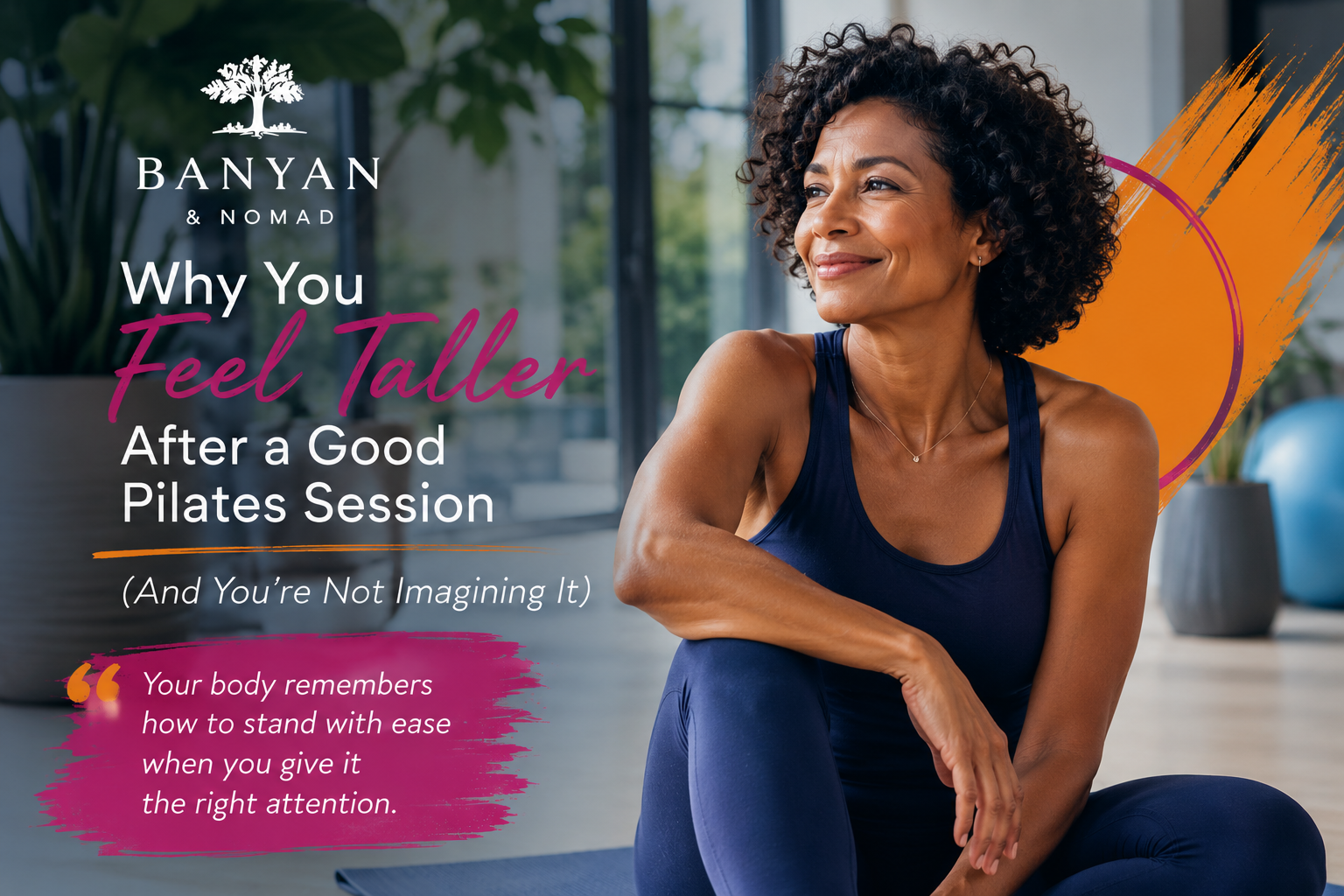
Why You Feel Taller After a Good Pilates Session (And You're Not Imagining It)
Every so often, someone walks out of a Pilates session, pauses for a moment, smiles, and says something I've heard countless times over the years: "I feel taller." Sometimes they laugh as they say it, almost apologetically, as though they're describing something too strange to be true. Others ask me if it's just their imagination. After all, it's impossible to gain an inch in height during a one-hour session... isn't it? The answer is both simple and fascinating. No, your bones haven't grown. But the feeling itself is absolutely real, and it's one of my favorite examples of how quickly the body responds when we give it the right kind of attention. That sensation of standing a little higher isn't an illusion. It's the result of your body reorganizing itself in ways that modern life often prevents. The more I learn about movement, the more I realize that our bodies are constantly adapting to the positions we ask them to maintain. We become a little shorter at our desks, a little more rounded over our phones, a little tighter after hours behind the wheel. Then, for one hour, we ask the body to remember something it has always known but has quietly forgotten: how to stand with ease instead of effort.
Your Spine Is More Dynamic Than You Think
Most people imagine the spine as a rigid column whose only job is to keep us upright. In reality, it is one of the most adaptable structures in the human body. Made up of thirty-three vertebrae separated by discs that act as cushions, the spine is designed to move, absorb force, distribute weight, and continuously respond to the demands we place upon it. Throughout the day, gravity gently compresses those discs. Hours spent sitting, leaning forward, or remaining in the same position gradually increase that compression, while the muscles surrounding the spine begin working harder to compensate for inefficient posture.
One of the beautiful things about Pilates is that it encourages the spine to move in every direction it was designed to explore. We flex, extend, rotate, lengthen, stabilize, and breathe into movements that many people haven't practiced in years. As those surrounding muscles begin working together more efficiently, unnecessary tension starts to ease. The spine isn't magically stretching beyond its normal length. Instead, it is reclaiming the space and alignment that poor habits have slowly taken away. What many people interpret as suddenly becoming taller is often the body returning to a more natural relationship with gravity.
Your Brain Is Updating the Way It Sees You
One of the things I find most fascinating is that this experience isn't only physical. It's neurological. Every second of every day, your brain is maintaining an internal map of where your body exists in space. Scientists call this body schema, and it allows us to move without consciously calculating every step, reach, or turn. The remarkable thing is that this map is constantly being updated based on the information your nervous system receives from your muscles, joints, skin, eyes, and inner ear.
When movement becomes repetitive, that internal map can become surprisingly limited. Many people spend years operating within a relatively small range of positions: sitting, driving, standing at a kitchen counter, looking down at a laptop or a phone. During a Pilates session, the brain suddenly receives an enormous amount of new sensory information. Different muscles begin contributing to movement, joints travel through healthier ranges, breathing becomes deeper, and posture changes. The brain notices. It updates its map. Sometimes that new map simply feels bigger, lighter, and more upright. The feeling of being taller isn't just about posture. It's also about perception. Your brain is recognizing a body that is moving more efficiently than it was an hour earlier.
Breathing Creates More Space Than We Realize
If you've ever attended one of my sessions, you've probably noticed how often I talk about breathing. Some people assume it's simply there to help them relax, but breathing is also one of the most important movement tools we have. Every full breath gently influences the position of the rib cage, the mobility of the thoracic spine, and the relationship between the diaphragm, abdominal muscles, and pelvic floor. These structures work together far more closely than most people realize.
Many of us spend our days taking surprisingly shallow breaths. Stress, prolonged sitting, and poor posture all encourage the chest to become less mobile over time. When breathing becomes restricted, the body often compensates by tightening the neck, shoulders, and upper back. During Pilates, as breathing becomes slower and more expansive, the rib cage begins moving more freely. The chest opens, the shoulders settle into a more comfortable position, and the entire upper body often feels less compressed. Clients frequently describe this as feeling "lighter." I suspect what they're really experiencing is the extraordinary difference that happens when the body no longer has to fight against unnecessary tension with every breath.
Good Posture Isn't About Standing Up Straight
Posture has suffered from terrible marketing. For years, many of us were taught to imagine someone pulling a string from the top of our head or to force our shoulders back as far as possible. The result is often stiffness rather than good movement. Healthy posture isn't something we hold. It's something that emerges naturally when the body is balanced, mobile, and working as a coordinated system. It isn't rigid. It breathes. It adapts. It responds to whatever life asks us to do.
This is one of the reasons I rarely tell clients to "stand up straight." Instead, I help them move better. As movement improves, posture usually follows on its own. The head begins balancing more comfortably over the spine. The shoulders no longer need to round forward. The pelvis finds a more efficient position. Weight becomes more evenly distributed through the feet. None of these changes happen because someone is trying harder. They happen because the body has rediscovered a more economical way of organizing itself. That economy is often what people interpret as elegance.
The Feeling Is More Important Than the Measurement
Every now and then, someone jokingly asks if they should measure themselves before and after class. I always smile because I understand the curiosity, but I think they're asking the wrong question. The more meaningful question is this: how do you feel inside your own body? Do you breathe more easily? Does walking feel lighter? Are your shoulders less tense? Do you notice yourself standing with greater confidence while waiting in line or talking to someone? Those are the changes that genuinely matter because they extend far beyond the studio.
My hope has never been to help people become better at Pilates. My hope is that they leave each session feeling more at home in their own body than when they arrived. If that means they walk out believing they are a little taller, I don't rush to correct them. Perhaps, in the ways that truly matter, they are. Not because they have changed their height, but because they have rediscovered the space, confidence, and ease that had been quietly compressed by everyday life.
Here's My Final Tip
The next time you finish a Pilates session and catch yourself thinking, "I feel taller," don't dismiss the feeling.
Pause for a moment.
Notice your breathing. Notice how your feet meet the ground. Notice how easily your shoulders rest, how freely your head balances, and how much lighter your next few steps feel.
Your body is telling you something important.
It isn't asking to become someone different.
It's simply reminding you of the way it was always meant to move.
Mantra: True posture isn't something I create. It's something I uncover.
With mindfulness,
Elena