
People Who Need Control Often Struggle Most With Balance
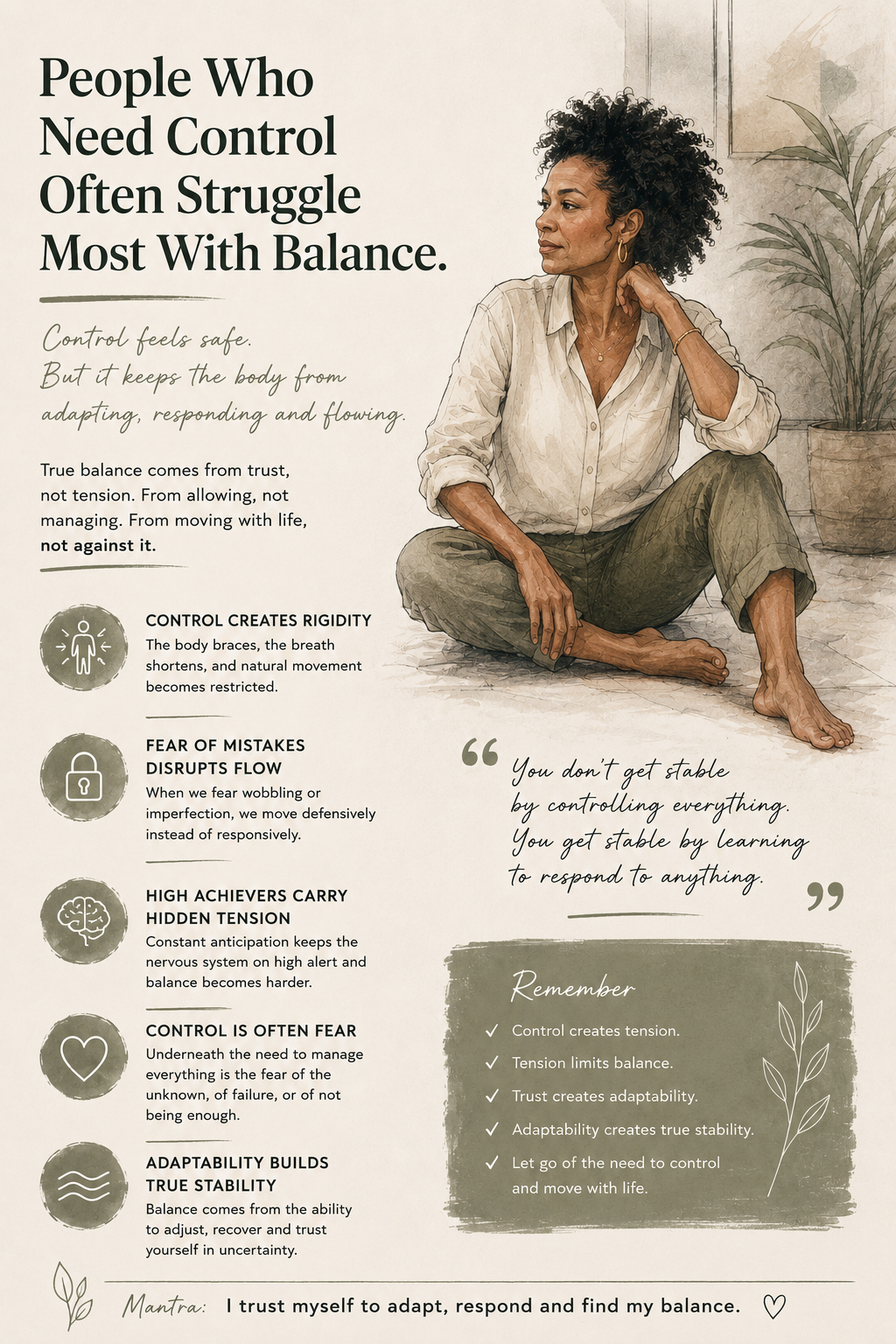
One of the greatest misconceptions people have about balance is that it comes from control. Tighten more. Stabilize more. Grip harder. Focus harder. Stay perfectly centered. The entire language surrounding balance often sounds like the language of domination, as if the body becomes more stable the more aggressively we try to manage every movement inside it.
But after years of working with people, I have found something that surprises many of them: some of the people who struggle most with balance are not careless people. They are highly controlled people.
They are intelligent, disciplined, hyper-aware, successful, organized, responsible people who spend most of their lives trying to anticipate everything before it happens. And that exact pattern often appears in the body. The nervous system becomes less adaptable because it is constantly trying to predict, manage, brace, and avoid uncertainty. But balance does not actually thrive inside rigidity. Real balance depends on responsiveness. And responsiveness requires a willingness to stop controlling every second before it arrives.
Control Creates Physical Rigidity Faster Than People Realize
The body tells the truth about personality long before most people are ready to admit it.
People who need excessive control often move with hidden tension patterns they no longer notice because those patterns have become normal. The jaw tightens. The breath becomes shallow. The toes grip the floor. The shoulders subtly brace. Weight shifts become cautious and overly managed. Instead of responding naturally to movement, the body begins pre-managing movement before it even happens.
And that changes balance profoundly.
Real balance depends on micro-adjustments. Tiny reactions. Adaptability. Fluidity. But a body organized around control becomes less fluid over time because it is constantly trying to eliminate unpredictability. The irony is that the harder people try to control balance, the more unnatural their movement often becomes.
People Who Fear Mistakes Move Differently
This is something I wish more movement professionals talked about honestly.
Fear of mistakes changes coordination.
The moment someone becomes emotionally uncomfortable with wobbling, uncertainty, correction, or visible imperfection, the body starts moving defensively. Movements become overcontrolled instead of responsive. People hesitate before stepping. They overthink transitions. They tighten before shifting weight. Instead of allowing the nervous system to react organically, they attempt to micromanage every movement consciously.
That is exhausting for the body.
Balance is not perfection. It is recovery. It is the ability to lose orientation briefly and reorganize without panic. But many adults have become so intolerant of mistakes that even temporary instability feels emotionally threatening. The nervous system interprets wobbling like failure instead of information.
Myth: Stable People Are Highly Controlled
Truth: Truly Stable People Adapt Quickly
This is one of the biggest misunderstandings in both movement culture and life in general.
People often confuse control with stability because rigid systems can appear organized temporarily. But true stability is not about freezing movement into perfection. It is about flexibility inside unpredictability.
Watch a healthy body respond to instability naturally and you will notice something important: it does not panic. It adjusts. The body shifts, reorganizes, recovers, recalibrates, and continues. That is balance.
Hyper-controlled people often interrupt this process because they are trying so hard to prevent imperfection that they block the body’s natural adaptability. They become stiff precisely where flexibility is needed most. And the nervous system pays for that rigidity over time.
High Achievers Often Live Inside Anticipatory Tension
This is especially true for highly productive people.
Many successful adults spend years living in a constant state of anticipation. Planning. Managing. Preventing problems. Thinking ahead. Monitoring outcomes. Remaining prepared. Their nervous system rarely gets the opportunity to fully settle because life becomes one continuous process of staying ahead of what could go wrong.
Eventually the body learns that pattern.
I often see people who look calm externally but move as if they are subtly bracing for impact at all times. Their breathing remains elevated. Their reactions are guarded. Their movement lacks softness even when they are technically strong. And because this state becomes familiar, they no longer recognize how much energy their body spends trying to maintain control constantly.
Balance becomes difficult because the body never fully trusts the moment it is inside.
Control Is Often Fear Wearing Expensive Clothing
Control is socially rewarded, which is why people rarely question it deeply.
The organized person is praised. The productive person is admired. The person who appears composed and prepared is considered responsible. But underneath excessive control there is often fear. Fear of uncertainty. Fear of embarrassment. Fear of vulnerability. Fear of failure. Fear of unpredictability.
The body absorbs these fears physically.
People who struggle to tolerate uncertainty emotionally often struggle to tolerate instability physically. They want movement to feel guaranteed before they commit to it. They want certainty before shifting weight. They want assurance before trusting reactions. But balance cannot emerge from constant emotional negotiation with uncertainty.
Balance requires participation before guarantees exist.
Social Media Has Made Controlled Movement Look “Correct”
This has made the problem even worse.
Online movement culture rewards polished movement constantly. Controlled poses. Perfect alignment. Clean aesthetics. Stable-looking exercises filmed under ideal conditions. The result is that people begin believing movement should always appear graceful and managed.
But real movement is messy.
Real movement includes wobbling, adjusting, correcting, reacting, missing timing occasionally, recovering, recalibrating, and finding rhythm again. That is not failure. That is how intelligent systems learn.
Unfortunately, many adults now become embarrassed the moment movement stops looking polished. And the more self-conscious they become, the less naturally they move.
The Nervous System Learns Safety Through Adaptation, Not Perfection
A nervous system becomes more resilient when it learns that instability is survivable.
This is true emotionally and physically.
The body gains confidence not by eliminating uncertainty entirely, but by experiencing uncertainty repeatedly and discovering it can recover. Every time the body wobbles and reorganizes successfully, trust grows. Every time a person experiences imperfection without shame, adaptability increases.
But highly controlling people often interrupt this process because they attempt to avoid instability altogether. They want certainty before movement instead of building certainty through movement itself.
And unfortunately, avoidance weakens trust far more than imperfection ever does.

Real Balance Requires Letting Go of the Illusion of Total Control
This may be the hardest lesson of all.
The body cannot become fully adaptable while the mind remains obsessed with certainty. At some point, balance asks for participation instead of perfection. It asks for responsiveness instead of management. It asks for trust instead of constant supervision.
That does not mean becoming careless. It means becoming less rigid.
The people who move most fluidly are often not the people controlling themselves the hardest. They are the people who trust their ability to respond when life shifts unexpectedly. Their nervous system does not collapse every time movement becomes uncertain because they are no longer trying to eliminate unpredictability completely.
And perhaps this is true far beyond movement itself.
🌿 Here’s my final tip
The next time you feel unstable, ask yourself something deeper than “How do I control this better?”
Ask:
“What would happen if I trusted myself to adapt instead?”
Sometimes balance begins exactly where control loosens its grip.
Mantra: “I do not build stability through rigidity. I build it through trust and response.”
With mindfulness,
Elena