
Practical Pilates exercises to strengthen your hips, improve stability, and move with greater confidence.
Have you ever noticed how much balance is involved in the smallest everyday movements? Stepping into a pair of trousers, reaching into a cupboard, getting out of a low chair, or turning around while carrying something all require our muscles to work together in remarkably precise ways.
We don't usually think about these movements until they begin to feel less comfortable. Perhaps you find yourself holding onto furniture more often, feeling uncertain when changing direction, or noticing that one leg seems steadier than the other. These changes can happen gradually, and they often prompt an important question: can exercise help us feel more stable again?
One of the reasons I love Pilates is that it teaches us to pay attention to how we move. Rather than focusing exclusively on how many repetitions we can complete, we explore the relationship between strength, alignment, breathing, and control. These are all qualities that contribute to balance.
But Pilates isn't a magic solution, and not every Pilates exercise is equally useful for improving stability. The real benefits come from choosing appropriate movements, practicing consistently, and gradually introducing challenges that reflect the demands of everyday life.
Let's look at what the research tells us and, more importantly, how we can put that knowledge into practice.
Does Pilates Really Improve Balance After 50?
Yes. Research suggests that Pilates can improve static balance, dynamic balance, strength, and functional mobility in older adults. However, the strongest evidence comes from studies involving people aged 60 and older, and improvements in balance tests don't necessarily mean that Pilates alone will prevent falls.
A 2024 systematic review and meta-analysis published in Complementary Therapies in Clinical Practice examined 39 studies involving 1,770 older adults. Researchers found that Pilates improved several measures of standing and moving balance compared with control groups.
Interestingly, Pilates was generally comparable to other exercise approaches rather than consistently superior to them. The researchers also found insufficient evidence to conclude that Pilates reduced the actual number of falls or fear of falling.
Another systematic review published in Healthcare in 2023 examined randomized controlled trials and similarly found that Pilates could be a useful intervention for improving balance in older adults.
What does this mean in practical terms?
It means Pilates is a valuable option, particularly when we combine it with exercises that specifically challenge standing stability, coordination, and lower-body strength. We don't need to choose between Pilates and balance training. We can use them together.
In my approach to movement, I see Pilates as a foundation that helps us develop strength and control, while more functional balance exercises allow us to apply those abilities to standing, walking, and navigating our surroundings.
Which Pilates Exercises Are Best for Improving Balance?
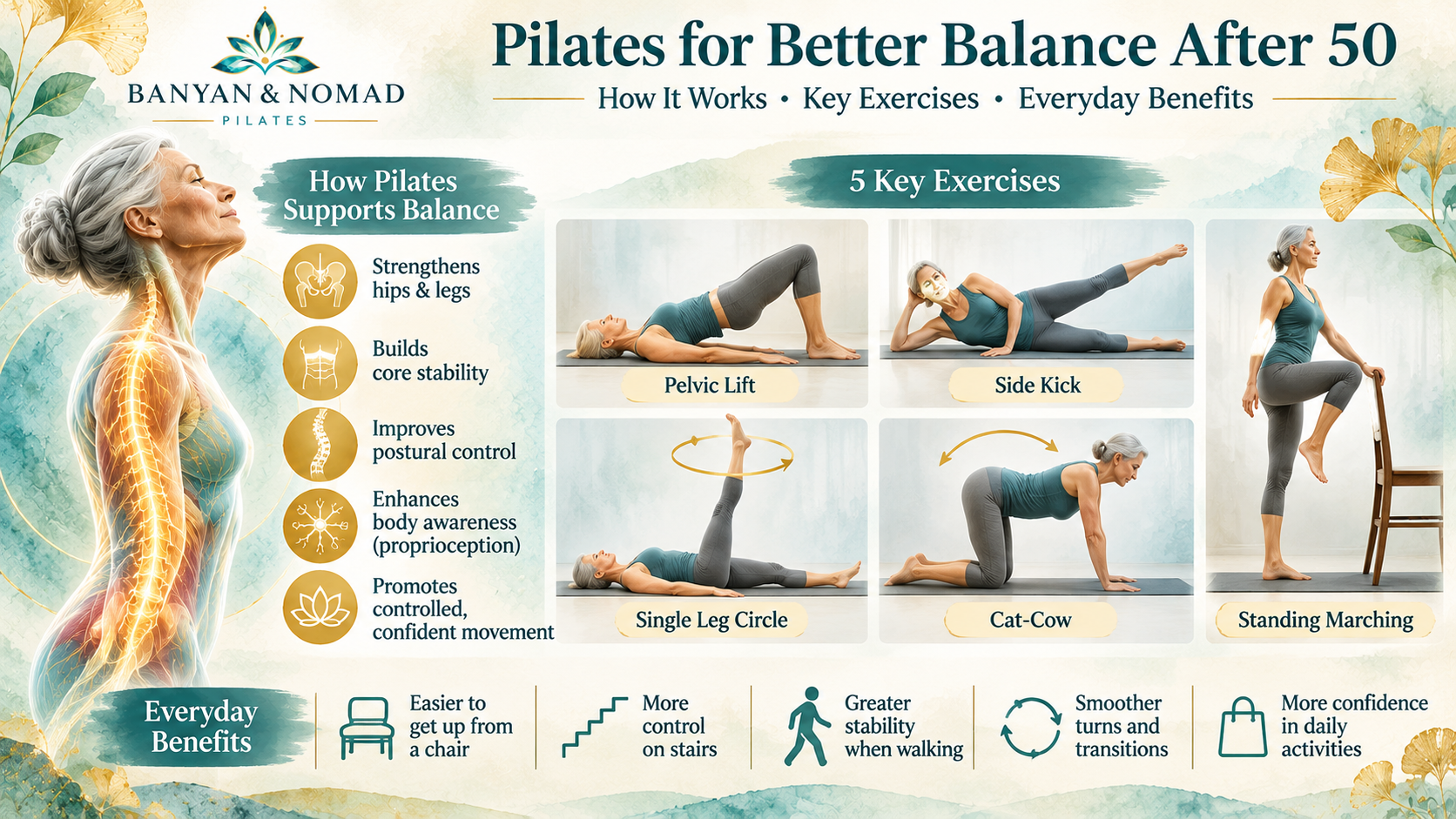
Pilates exercises that strengthen the hips, abdominal muscles, back, and legs can support better balance. Pelvic lifts, side kicks, controlled leg circles, and standing Pilates movements are particularly useful because they develop the muscular control needed to stabilize the body.
I prefer to begin with exercises that allow us to understand the movement before adding more difficult balance challenges.
Here are five Pilates exercises I frequently return to, including several that appear throughout my eight-week Balance Program.
1. Pelvic Lift: Building Strength Through the Hips
The Pelvic Lift, often called a bridge, is one of my favorite starting points because it strengthens the muscles around the hips and pelvis while allowing us to work from a supported position.
How to practice: Lie on your back with your knees bent and your feet resting comfortably on the mat. Gently engage your abdominal muscles and lift your pelvis, keeping the movement controlled. Lower slowly, maintaining awareness of how the spine and hips move together.
Begin with approximately five to eight comfortable repetitions, resting whenever needed.
Why it matters: The gluteal muscles help stabilize the pelvis when we stand, walk, and climb stairs. When these muscles aren't contributing effectively, other parts of the body may compensate.
I like to encourage people to notice whether they feel both sides of the pelvis working evenly. Sometimes one side feels more active or easier to control than the other. That observation can help us become more aware of our movement patterns.
In The Balance Program, we gradually develop this exercise into variations involving alternating heel slides, which introduce additional demands on pelvic stability.
Everyday connection: Getting out of a chair, climbing stairs, and maintaining control when stepping forward.
2. Side Kicks: Strengthening the Muscles That Keep Us Upright
Side Kicks are particularly useful because they challenge the muscles along the outside of the hips.
These muscles, especially the gluteus medius, play an important role in stabilizing the pelvis when we're standing on one leg.
And whether we realize it or not, walking involves repeatedly transferring our weight onto one leg.
How to practice: Lie comfortably on your side with your head supported and your body aligned. Lift the upper leg slightly and move it forward and backward through a small, controlled range.
Start with five gentle movements in each direction, then change sides.
The goal isn't to lift the leg as high as possible. I would much rather see a smaller movement performed with good control than a larger one that causes the pelvis to roll backward or forward.
In the program, we explore different Side Kick variations, including circles and carefully selected resistance exercises.
Everyday connection: Walking, stepping sideways, moving around furniture, and maintaining stability while dressing.
3. Single Leg Circle: Learning to Stabilize While Moving
Single Leg Circle teaches an important principle: one part of the body can move while another remains stable.
How to practice: Lie on your back and extend one leg upward within a comfortable range, keeping the other leg bent with its foot on the floor if needed. Draw small, controlled circles with the raised leg while keeping the pelvis steady.
Begin with three to five circles in each direction before changing legs.
This exercise can reveal how much we depend on movement through the pelvis when the hip becomes challenged.
I often encourage people to make the circles smaller than they initially expect. Small circles give us an opportunity to recognize exactly when the pelvis begins to move.
The exercise develops hip control and abdominal stability without requiring us to stand.
Everyday connection: Moving one leg while maintaining a stable trunk, such as stepping over a low obstacle or getting into a car.
4. Cat-Cow: Improving Spinal Mobility and Body Awareness
Cat-Cow may not immediately seem like a balance exercise, but it helps us explore how the spine moves and how the abdominal and back muscles contribute to postural control.
How to practice: Begin on your hands and knees, using padding beneath the knees if needed. Gently alternate between rounding and lengthening the spine, coordinating the movement with comfortable breathing.
If getting onto the floor isn't practical, a seated variation can be performed in a sturdy chair.
I find this movement particularly valuable when someone tends to hold unnecessary tension through the shoulders or lower back.
Balance doesn't require us to keep the entire body rigid. We need enough stability to control movement, but also enough mobility to respond when our position changes.
Everyday connection: Turning, reaching, bending, and adjusting posture throughout the day.
5. Standing Marching: Bringing Pilates Into Everyday Movement
Standing Marching is where our Pilates practice begins to resemble the balance challenges we encounter in daily life.
How to practice: Stand beside a sturdy countertop or chair. Gently engage the abdominal muscles and lift one knee a comfortable distance from the floor. Lower the foot with control before repeating on the other side.
Begin with five repetitions per leg, keeping one hand on your support whenever necessary.
As control improves, we can introduce different arm positions or variations in the direction of the knee lift.
One detail I always emphasize is the supporting hip. It's easy to concentrate entirely on the leg we're lifting, but the standing leg is responsible for keeping the pelvis and trunk stable.
This is a useful exercise for recognizing the difference between simply lifting a knee and maintaining balance while lifting it.
Everyday connection: Walking, climbing stairs, stepping over objects, and changing direction.
Can Beginners Over 60 Start Pilates Safely?
Yes. Many adults over 60 can begin Pilates safely when exercises are adapted to their strength, mobility, and health needs. Chair-based exercises, supported standing movements, and modified mat exercises can provide accessible starting points without requiring advanced flexibility or previous Pilates experience.
One of the misconceptions I frequently encounter about Pilates is that people imagine they must be able to perform complicated movements on a mat before they can benefit.
They see photographs of perfectly straight legs, deep spinal curls, and impressive balancing positions, then decide Pilates isn't for them.
But those images represent only a small part of what Pilates can offer.
We can practice abdominal engagement while seated. We can strengthen the hips while lying comfortably on a mat. We can explore standing balance while holding a countertop.
The important question isn't whether someone can perform the most advanced version of an exercise. It's whether we can find a version that provides an appropriate challenge without compromising safety.
For someone with significant osteoporosis, recent surgery, persistent pain, or a history of falls, certain movements may require modification or professional guidance. Deep spinal flexion and loaded twisting, for example, may be inappropriate for some people with osteoporosis.
I also believe that being able to get down onto the floor should never be a prerequisite for beginning a movement program. We can work toward that ability gradually, or choose alternatives that meet the same training goals.
Is Pilates Better Than Walking for Balance?
Pilates and walking offer different benefits, and neither needs to replace the other. Walking supports cardiovascular health and everyday mobility, while Pilates can provide more targeted strengthening, postural control, and movement coordination. A combination is often more useful than relying on either activity alone.
Walking is one of the most accessible forms of physical activity, and I encourage people to continue walking when it's safe and comfortable for them.
However, walking on a familiar, level surface doesn't necessarily challenge every component of balance.
For example, walking may not provide much focused practice in maintaining stability while moving one leg sideways, controlling the pelvis during a slow weight transfer, or strengthening the muscles that stabilize the trunk.
Pilates can help address some of those areas.
Likewise, someone who practices Pilates exclusively on a mat may develop excellent abdominal strength but still need more experience with standing balance, stepping, and changes in direction.
This is why I prefer a combination of exercises rather than expecting one activity to accomplish everything.
The CDC recommends that adults aged 65 and older include aerobic activity, muscle-strengthening exercises, and balance activities in their weekly routines.
Each contributes something valuable.
How Often Should You Do Pilates to Improve Balance?
Practicing Pilates two or three times per week can be a reasonable starting point, depending on your experience and physical condition. Balance training should also be included regularly, with exercise difficulty and duration adjusted to individual abilities.
Research studies use different schedules, so there isn't one universally established Pilates frequency that guarantees better balance.
For someone beginning a movement routine, I would rather see two manageable, consistent practices each week than an ambitious schedule that quickly becomes exhausting.
Shorter exercises can also be incorporated between longer practices.
For example, you might practice a few Pelvic Lifts and Side Kicks during one session, then spend several minutes on supported standing balance the following day.
The key is to provide enough challenge to encourage improvement while allowing the body to recover.
A Simple 15-Minute Pilates and Balance Routine
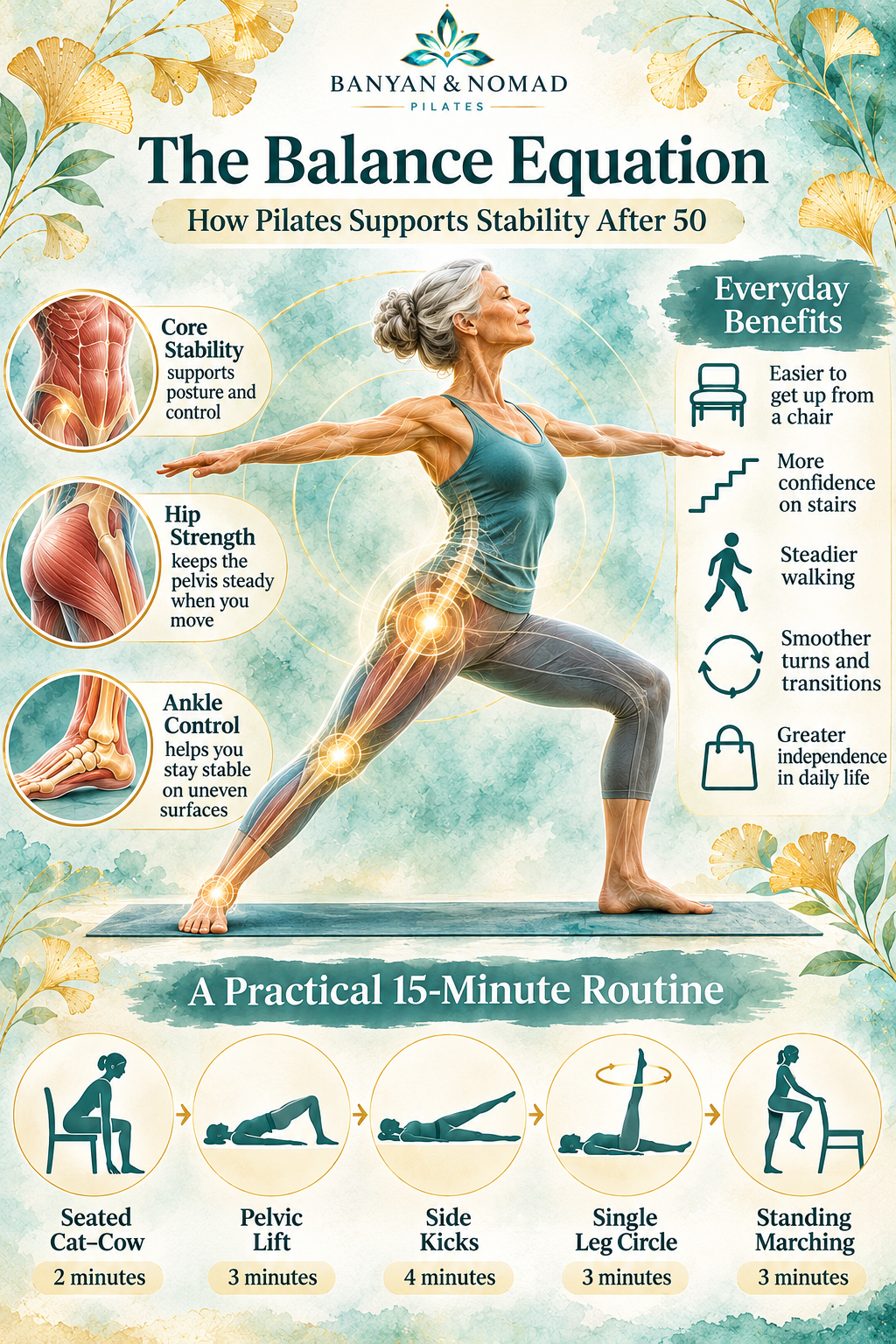
If you're looking for a practical starting point, here's a gentle routine that combines several of the movements we've discussed. You can complete the exercises in the following order, adjusting the time and repetitions to your abilities.
First 2 minutes: Seated or Supported Cat-Cow
Begin with gentle spinal movements to loosen the back, coordinate your breathing, and prepare your body for exercise. Move slowly between rounding and lengthening the spine without forcing the movement.
Next 3 minutes: Pelvic Lift
Lie on your back with your knees bent and feet resting on the mat. Perform five to eight controlled pelvic lifts, lowering slowly between repetitions. Take a short rest and repeat if comfortable.
Next 4 minutes: Side Kicks
Lie on your side with your head supported. Practice small, controlled forward and backward leg movements, then change sides. Focus on keeping your pelvis stable rather than increasing the size of the movement.
Next 3 minutes: Single Leg Circle
Return to lying on your back. With one knee bent and the other leg lifted comfortably, draw three to five small circles in each direction. Change legs and repeat, keeping your pelvis as steady as possible.
Final 3 minutes: Supported Standing Marching
Stand beside a sturdy countertop or chair. Slowly lift one knee, lower the foot, and alternate legs. Keep your movements controlled and use your support whenever needed.
These suggested times include brief rests and transitions. There's no need to move continuously for the entire 15 minutes.
If getting onto the floor is difficult, you can substitute appropriate chair-based exercises or supported standing variations.
I particularly like this sequence because it begins with spinal mobility, develops hip strength and abdominal control, and finishes with a standing activity that relates directly to everyday movement.
It also provides an opportunity to notice how your body responds in different positions. You may feel comfortable and coordinated on the mat but less confident when standing, or the opposite may be true.
Neither experience represents failure. It simply gives us useful information about what to practice next.
Can Pilates Help Prevent Falls?
Pilates may improve several physical abilities associated with fall risk, including strength, balance, and functional mobility. However, current research does not conclusively establish that Pilates alone reduces the number of falls in older adults.
This distinction is important because improving a balance test and preventing a real-world fall aren't exactly the same outcome.
A 2024 systematic review found improvements in balance measures but did not establish a reduction in actual falls or fear of falling.
Earlier reviews reported promising findings, although researchers also highlighted limitations in study quality and the amount of direct evidence on falls.
For people concerned about falling, a comprehensive approach may include strength training, challenging but appropriate balance exercises, reviewing medications, addressing vision problems, improving home safety, and seeking medical assessment when needed.
Pilates can be one valuable part of that approach.
I never want someone to feel that completing a particular exercise means they are suddenly protected from falling. What we can do is work on the physical abilities that help us move more confidently and respond to everyday challenges.
How Do You Know If Your Balance Is Improving?
Improvement may appear as greater control during familiar exercises, smoother transitions, or more confidence with everyday movements. Formal assessments can also measure progress, but noticing changes in daily activities can provide useful information.
Rather than concentrating exclusively on how long you can stand on one leg, consider what happens during ordinary activities.
Can you rise from a chair with less effort? Do you feel more stable when turning? Are you better able to control your movement when stepping sideways? Can you complete familiar exercises with less unnecessary tension?
These are observations worth paying attention to.
I encourage people to notice the quality of their movements as well as the difficulty.
Perhaps your pelvis remains steadier during Side Kicks. Maybe you no longer need to concentrate quite so intensely during a supported marching exercise. Or you may recognize when you're tired and adjust your movement before your balance deteriorates.
That growing awareness is part of learning to move well.
Progress is rarely perfectly linear, and our balance can change from day to day. Fatigue, illness, medication changes, pain, and other factors may influence how steady we feel.
If you experience new or worsening unsteadiness, repeated falls, fainting, or dizziness, seek appropriate medical evaluation rather than attempting to manage the problem through exercise alone.
Bringing Strength, Balance, and Confidence Together
What I appreciate most about Pilates is that it encourages us to understand movement rather than simply perform it.
We begin to recognize how the hips support the pelvis, how the abdominal muscles contribute to posture, and how breathing and controlled movement influence the way we use our bodies.
But the real value comes when we carry that awareness beyond the mat.
We want to feel comfortable standing up, walking outdoors, reaching for something, stepping around an obstacle, and participating in the activities that matter to us.
That requires more than one exercise, one muscle group, or one type of movement.
It requires a thoughtful combination of strength, mobility, balance, coordination, and consistent practice.
And that's exactly the approach I believe in.
Coming Soon: The Balance Program
I'm excited to announce that The Balance Program will be launching very soon on Podia!
I've created this eight-week program to bring together Pilates, balance training, strength, coordination, mindful movement, and restorative exercises in a structured, supportive way.
Throughout the program, we'll build on familiar movements, gradually introduce new challenges, and explore practical ways to develop greater stability and confidence in everyday life.
To celebrate the launch, The Balance Program will be available at special introductory pricing for a limited time.
If you'd like to make balance and mobility a more intentional part of your life, I'd love for you to join me.
Stay tuned for the official launch and take advantage of this special introductory offer!
With mindfulness,
Elena
Research & Further Reading
Campos Júnior et al. (2024). Effects of Pilates exercises on postural balance and reduced risk of falls in older adults: A systematic review and meta-analysis. Complementary Therapies in Clinical Practice.
https://pubmed.ncbi.nlm.nih.gov/39068875/Sampaio et al. (2023). The Effectiveness of Pilates Training Interventions on Older Adults' Balance: A Systematic Review and Meta-Analysis of Randomized Controlled Trials. Healthcare.
https://pmc.ncbi.nlm.nih.gov/articles/PMC10706653/Fernández-Rodríguez et al. (2021). Pilates improves physical performance and decreases risk of falls in older adults: A systematic review and meta-analysis. Physiotherapy.
https://pubmed.ncbi.nlm.nih.gov/34332493/da Silva, Shiel & McIntosh (2021). Pilates Reducing Falls Risk Factors in Healthy Older Adults: A Systematic Review and Meta-Analysis. Frontiers in Medicine.
https://pubmed.ncbi.nlm.nih.gov/34540865/Exercise Modalities for Overall and Domain-Specific Balance Performance in Older Adults (2026). Systematic review and network meta-analysis comparing different exercise approaches.
https://pubmed.ncbi.nlm.nih.gov/42600321/Centers for Disease Control and Prevention. Older Adults: Adding Activity Recommendations. Guidance on aerobic, strengthening, and balance activities.
https://www.cdc.gov/physical-activity-basics/adding-older-adults/index.html