
Understanding your body's hidden sense of movement, why it changes with age, and how you can strengthen it.
Have you ever walked across a dark room without looking at your feet? Reached behind your back to fasten a necklace? Or stepped onto an uneven sidewalk and adjusted your footing before you had time to think about it?
These everyday actions depend on a remarkable sensory ability called proprioception. It's something most of us use constantly without knowing its name, and it plays an essential role in how confidently we move through the world.
When we talk about balance, we often think about strong legs, good posture, or the ability to stand on one foot. Those things certainly matter, but balance is also a sensory experience. Our brains need a continuous stream of information about where our bodies are, how our joints are positioned, and how our muscles are responding to movement.
In my work with movement and balance, I find it especially useful to help people understand this connection. Strengthening a muscle is important, but learning to recognize how that muscle contributes to stability can make our movement practice much more meaningful.
Let's explore proprioception, what research tells us about its relationship with aging, and how we can train this often-overlooked sense.
What Is Proprioception?
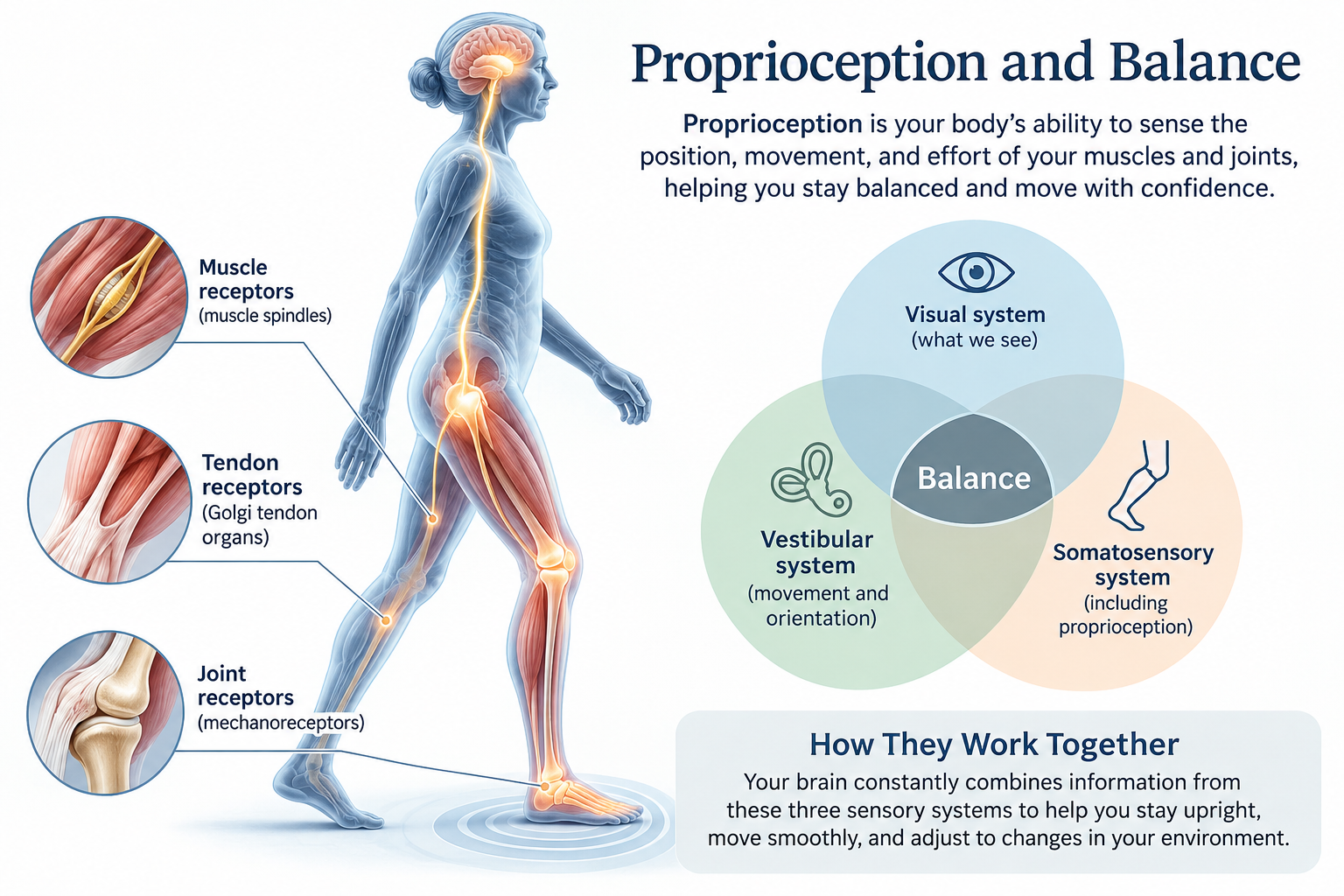
Proprioception is the body's ability to sense the position and movement of its parts without relying on vision. Specialized receptors in our muscles, tendons, and joints send information to the nervous system, helping us understand where our limbs are and how they are moving.
Think about lifting your arm above your head while keeping your eyes closed. You don't need to look at your arm to know approximately where it is. Your nervous system is constantly receiving information about the changing position of your shoulder, elbow, and wrist.
The same thing happens when you walk. Your ankles, knees, hips, and trunk continuously provide sensory information that helps your brain coordinate movement.
Proprioception is closely related to another concept called kinesthesia, which refers specifically to our sense of movement. Together, these abilities contribute to the internal awareness that allows us to move without constantly monitoring every joint.
One example I like to use is walking up a staircase. We rarely look directly at each foot throughout the entire climb. Instead, we rely on a combination of vision, proprioception, muscle strength, and previous experience to judge the height of each step and position our feet appropriately.
When that coordination becomes less reliable, even familiar activities can begin to require more attention.
How Does Proprioception Affect Balance?
Proprioception helps us maintain balance by informing the brain about joint position, body movement, and changes in our support. The brain combines this information with signals from our eyes and vestibular system in the inner ear to coordinate the muscular responses that keep us upright.
These three sensory systems work together, but each contributes something different.
Our visual system helps us understand our surroundings and our position in relation to objects. Our vestibular system detects head movement and orientation relative to gravity. Our somatosensory system, which includes proprioception and information from pressure and touch receptors, tells us what is happening within our body and where we are making contact with the ground.
Imagine standing on a firm floor and then stepping onto thick grass. The information coming from your feet and ankles changes because the surface responds differently to your weight.
Your brain must interpret those changing signals and adjust muscle activity to maintain stability.
This is why balance training should involve more than simply holding a position. We also need to practice responding to movement, changing our weight distribution, and adapting to different conditions.
In The Balance Program, I use exercises that challenge these abilities in different ways. Sometimes we practice slow, deliberate weight transfers. At other times, we introduce a stability disc, controlled leg movements, or an activity that requires the upper and lower body to work together.
The intention is not to make movement unnecessarily difficult. It's to help the nervous system become more practiced at interpreting information and organizing an appropriate response.
Does Proprioception Decline With Age?
Some aspects of proprioception can become less accurate with age, particularly our ability to detect subtle changes in joint position and movement. However, aging affects people differently, and reduced balance can also involve changes in muscle strength, vision, vestibular function, sensation, medication effects, and health conditions.
As we grow older, sensory receptors and the nervous system may become less responsive or efficient. We may also experience changes in muscle mass, joint mobility, and the speed at which we respond to unexpected movement.
Consider what happens when you catch your foot on the edge of a rug. Maintaining your balance requires you to recognize the change in movement, activate the appropriate muscles, and reposition your body quickly enough to prevent a fall.
If sensory information becomes less precise or muscular responses become slower, recovering from that unexpected movement may be more difficult.
Research supports the importance of sensory information in age-related balance changes. A 2025 systematic review and meta-analysis involving 64 studies and 4,481 participants examined how older adults respond when visual or proprioceptive information is disrupted. The findings showed that sensory disturbances can significantly affect postural stability, particularly in older adults.
What I find encouraging is that changes in balance do not automatically mean we've lost the ability to improve it. The nervous system retains an important capacity to adapt through practice, and appropriately designed exercise can help us make better use of the abilities we have.
At the same time, persistent or newly developing balance problems deserve medical attention. We shouldn't assume that every change in stability is simply a normal consequence of aging.
Can You Improve Proprioception Through Exercise?
Yes. Exercises that challenge joint-position awareness, controlled weight shifting, and balance under different sensory conditions can improve aspects of balance and sensorimotor control. Research is promising, although the evidence varies in quality and does not establish that every proprioceptive exercise prevents falls.
A 2024 systematic review and meta-analysis by Sluga and Kozinc examined 12 studies of proprioceptive and sensorimotor exercise programs in older adults.
The researchers found improvements across several commonly used balance assessments, including the Berg Balance Scale, Timed Up and Go test, Functional Reach Test, and single-leg standing tests.
However, the authors rated the overall certainty of evidence as low or very low. This is an important distinction: the findings are encouraging, but we still need stronger studies to understand which specific approaches work best and for whom.
A 2026 systematic review examining multisensory training also reported improvements in balance and functional mobility across many of the included studies. The interventions involved combinations of proprioceptive exercises, unstable surfaces, visual feedback, and other sensory challenges.
For me, the practical lesson is that balance responds to purposeful, varied practice. We can challenge the body in different ways while still respecting individual abilities, comfort, and safety.
Here are several examples of how I incorporate these principles into movement practice.
What Are the Best Exercises to Improve Proprioception?
Useful proprioceptive exercises include controlled weight shifts, heel-to-toe walking, standing leg movements, supported single-leg balance, and carefully supervised unstable-surface activities. The most appropriate starting point depends on a person's current balance, strength, confidence, and fall risk.
1. Standing Weight Transfers
One of the simplest ways to explore proprioception is to shift our weight slowly from one foot to the other.
Stand near a sturdy countertop or chair and begin with both feet comfortably apart. Gradually transfer more weight onto one leg, then return to the center and move toward the other side.
Notice how the pressure changes beneath your feet and how the muscles around your ankles and hips respond.
I particularly like this exercise because it allows us to explore balance without requiring a dramatic movement. We can pay attention to the difference between moving our weight intentionally and simply leaning to one side.
This awareness becomes valuable when stepping sideways, changing direction, or reaching for something.
2. The Ankle Clock
In The Balance Program, we use an exercise called the Ankle Weights Clock.
The movement involves standing on one leg while extending the other in different directions, as though reaching toward positions on a clock face.
We explore forward, diagonal, sideways, and backward movements while maintaining stability through the supporting leg.
Although ankle weights can add resistance, they aren't necessary when first learning the movement.
What interests me about this exercise is the relationship between the moving leg and the standing leg. The moving leg attracts our attention, but the supporting hip, knee, and ankle are doing an enormous amount of work.
Learning to notice that relationship can help us develop more deliberate movement and better control over our weight distribution.
3. Heel-to-Toe Walking
Heel-to-toe walking, sometimes called tandem walking, challenges our balance by narrowing our base of support.
Instead of walking with our feet comfortably apart, we place one foot directly in front of the other.
This requires greater coordination through the ankles, hips, and trunk.
I often think of this as a useful reminder that walking isn't one single skill. Walking on a wide, clear path is different from navigating a narrow passage, stepping around furniture, or moving through a crowded room.
Practice beside a countertop or railing, with a hand available for support. There is no need to rush or complete a long distance.
4. Ball Tossing and Visual Tracking
Another exercise we explore in The Balance Program involves standing while tossing a small ball between the hands.
The activity introduces an additional demand because our attention and eyes follow the moving object while the rest of the body works to maintain stability.
For beginners, this can be practiced with both feet on a firm surface. More challenging variations may involve a narrower stance or, when appropriate, a stability disc.
This type of exercise reminds us that balance doesn't happen in isolation. In everyday life, we're often reaching, looking around, carrying objects, or responding to something happening nearby.
Our ability to coordinate these activities matters just as much as standing still.
5. Stability Disc Exercises
A stability disc creates a less predictable surface beneath the feet, requiring continuous small adjustments.
These adjustments challenge the integration of sensory information with muscular control.
In my program, we gradually introduce stability disc exercises, beginning with more manageable positions before exploring activities involving the arms, visual tracking, or changing weight distribution.
I want to emphasize that unstable surfaces aren't automatically better than firm ground. They are simply another training option, and they are not appropriate for everyone.
Someone who is already unsteady may benefit far more from practicing controlled standing and stepping on a firm floor than from attempting to balance on a moving surface.
If a stability disc is used, it should be introduced with appropriate supervision and reliable support.
Why Is It Harder to Balance With Your Eyes Closed?
Closing your eyes removes visual information that normally helps the brain maintain stability. Your body must then rely more heavily on proprioceptive, touch, and vestibular signals, making any limitations in those systems more noticeable.
You may have experienced this while washing your hair in the shower or standing in a dark room.
When visual information disappears, your nervous system must adjust how much it relies on the remaining sensory signals.
Researchers sometimes describe this process as sensory reweighting. The brain continually adjusts the relative importance of different sources of information depending on their availability and reliability.
This is one reason balance can feel different on a firm floor, a soft carpet, or an uneven outdoor surface.
However, deliberately closing your eyes during challenging balance exercises isn't necessary for everyone, and it can increase fall risk.
For people who are unsteady, maintaining clear vision and using stable support is the safer and more appropriate approach.
Why Do I Lose My Balance When I'm Distracted or Walking and Talking?
Walking while talking or concentrating on another task requires the brain to manage movement and attention simultaneously. This is called dual-tasking, and it can become more challenging when balance already requires greater conscious effort.
Think about walking through a busy grocery store while searching for a particular item, navigating other shoppers, and having a conversation.
Your body must continuously adjust its movement while your attention is divided between several activities.
In the final week of The Balance Program, we explore this relationship through an obstacle course that combines stepping, changing direction, and simple thinking activities, such as naming countries or authors alphabetically.
The purpose is to practice managing two demands at once, not to test how quickly someone can answer questions.
I find this connection especially interesting because it reflects how we actually move through life. We rarely walk around concentrating exclusively on our feet.
Dual-task training is an active area of research, and evidence suggests that appropriately structured activities can improve aspects of dynamic balance and mobility in older adults.
These exercises should always match the individual's abilities. Challenging obstacle courses, reduced visibility, and divided-attention activities are best introduced with supervision rather than attempted alone by someone at risk of falling.
How Often Should You Practice Proprioception Exercises?
Balance exercises are generally recommended at least three days per week for older adults, as part of a broader routine that includes strength and aerobic activity. The appropriate frequency and difficulty depend on individual needs, and consistency is more important than attempting advanced movements too soon.
The U.S. Physical Activity Guidelines recommend multicomponent physical activity for older adults, incorporating balance training alongside aerobic and muscle-strengthening activities.
In practice, this doesn't mean every exercise needs to become a lengthy workout.
A few minutes of controlled weight shifting, supported marching, or heel-to-toe walking can be a useful addition to an established routine.
I encourage people to think about balance practice as an opportunity to become more familiar with their bodies rather than another task they must perform perfectly.
Some days, you may feel stable and confident. Other days, fatigue, poor sleep, discomfort, or stress may affect your movement.
Learning to recognize those differences and adjust accordingly is itself an important part of body awareness.
Is Proprioception the Same as Balance?
No. Proprioception is one of the sensory abilities that contributes to balance, while balance is the broader process of maintaining or recovering stability. Balance depends on sensory information, muscle strength, coordination, attention, and the nervous system's ability to organize an appropriate response.
This distinction matters because no single exercise or sensory system can address every aspect of balance.
Someone may have excellent muscle strength but struggle with visual or vestibular challenges. Another person may have good sensory awareness but lack the lower-body strength needed to recover from a stumble.
That's why I prefer an integrated approach that includes strengthening, controlled movement, mobility, coordination, and mindful attention.
Our bodies don't experience these abilities as separate categories. They work together every time we stand, walk, reach, turn, or change direction.
Learning to Trust Your Body Again
One of the most meaningful aspects of balance training is the opportunity to rebuild confidence in movement.
When someone begins to feel unsteady, it's understandable that they may avoid activities that seem challenging. They might become hesitant about uneven sidewalks, stairs, crowded environments, or walking outdoors.
That caution can be protective, but excessive avoidance may also reduce opportunities to maintain strength and practice movement.
I believe we need to approach this relationship thoughtfully. Confidence shouldn't come from ignoring risk or pushing through fear. It should develop through preparation, appropriate support, gradual progress, and experiences that help us understand what our bodies can do safely.
Proprioception is part of that process. As we become more attentive to our position and movement, we can begin to recognize the subtle adjustments that support our stability.
And sometimes, progress is remarkably ordinary: turning more comfortably, stepping around an obstacle with less hesitation, or feeling steadier while carrying something across a room.
Those everyday improvements are worth celebrating.
Coming Soon: The Balance Program
I'm delighted to share that The Balance Program will be launching very soon on Podia!
I've designed this eight-week program to bring together Pilates, balance training, strengthening exercises, coordination, proprioceptive awareness, mindful movement, and restorative practices.
We'll explore how these different elements work together to support greater stability, confidence, and comfort in everyday life, with opportunities to adapt movements to individual abilities.
To celebrate the launch, The Balance Program will be available at special introductory pricing for a limited time.
If you've been thinking about giving your balance and mobility more attention, I'd love for you to join me.
Stay tuned for the launch announcement and take advantage of this special introductory opportunity!
With mindfulness,
Elena
Research & Further Reading
Sluga, S. P., & Kozinc, Ž. (2024). Sensorimotor and proprioceptive exercise programs to improve balance in older adults: A systematic review with meta-analysis. European Journal of Translational Myology.
https://pmc.ncbi.nlm.nih.gov/articles/PMC11017176/Impact of Sensory Afferences in Postural Control Quantified by Force Platform in Healthy Older Adults (2025). Systematic review and meta-analysis examining the contribution of visual and proprioceptive information to balance.
https://pubmed.ncbi.nlm.nih.gov/41314405/Effectiveness of Multisensory Exercises Versus Conventional Balance Exercises on Balance and Coordination in the Geriatric Population (2026). Systematic review of multisensory training approaches for older adults.
https://pmc.ncbi.nlm.nih.gov/articles/PMC13523123/Exercise Modalities for Overall and Domain-Specific Balance Performance in Older Adults (2026). Large systematic review and network meta-analysis comparing exercise approaches for balance.
https://pubmed.ncbi.nlm.nih.gov/42600321/Liang et al. (2024). The effect of adding real-time postural feedback in balance and mobility training in older adults: A systematic review and meta-analysis. Archives of Gerontology and Geriatrics.
https://pubmed.ncbi.nlm.nih.gov/38643641/U.S. Department of Health and Human Services. Physical Activity Guidelines for Americans, Second Edition. Recommendations for aerobic, strength, and multicomponent balance activity in older adults.
https://odphp.health.gov/moveyourway/