
Seven practical balance exercises to build strength, improve coordination, and feel more confident in everyday movement.
Think about the last time you stepped off a curb, reached for something on a high shelf, or turned around quickly because someone called your name. You probably didn't stop to consider how many adjustments your body made to keep you upright.
That's the remarkable thing about balance. Most of the time, it works quietly in the background.
As we get older, however, some of those automatic adjustments can become slower or less reliable. We might notice that uneven pavement requires more attention, that standing on one leg feels less comfortable, or that getting up from a chair takes more effort than it used to.
These changes don't necessarily mean we're destined to become unsteady. Balance is a skill involving several physical systems, and many of the abilities that support it can be improved through appropriate exercise.
In my work with older adults, I like to approach balance training as something practical and personal. We aren't trying to become circus performers or hold complicated positions for impressive lengths of time. We're developing the strength, coordination, and confidence that allow us to move through ordinary life with greater ease.
And we can begin with surprisingly simple exercises.
Before You Begin: What Does Good Balance Actually Require?
Balance isn't just about standing still without wobbling.
When you walk, reach, bend, or change direction, your body continually adjusts its position. Your muscles respond to information from your eyes, inner ears, joints, and nervous system, while your brain coordinates the movements needed to maintain stability.
Good balance depends on several abilities working together:
Leg and hip strength: To support your body and control your movements.
Postural control: To maintain an appropriate relationship between your head, trunk, and pelvis.
Weight shifting: To transfer your weight safely from one foot to the other.
Coordination: To organize movements smoothly, especially when changing direction.
Sensory awareness: To recognize where your body is positioned and respond to changes in the environment.
Reaction and adaptability: To make appropriate adjustments when something unexpected happens.
This explains why simply standing on one leg isn't enough to develop every aspect of balance.
A useful exercise routine should challenge different abilities, gradually and safely.
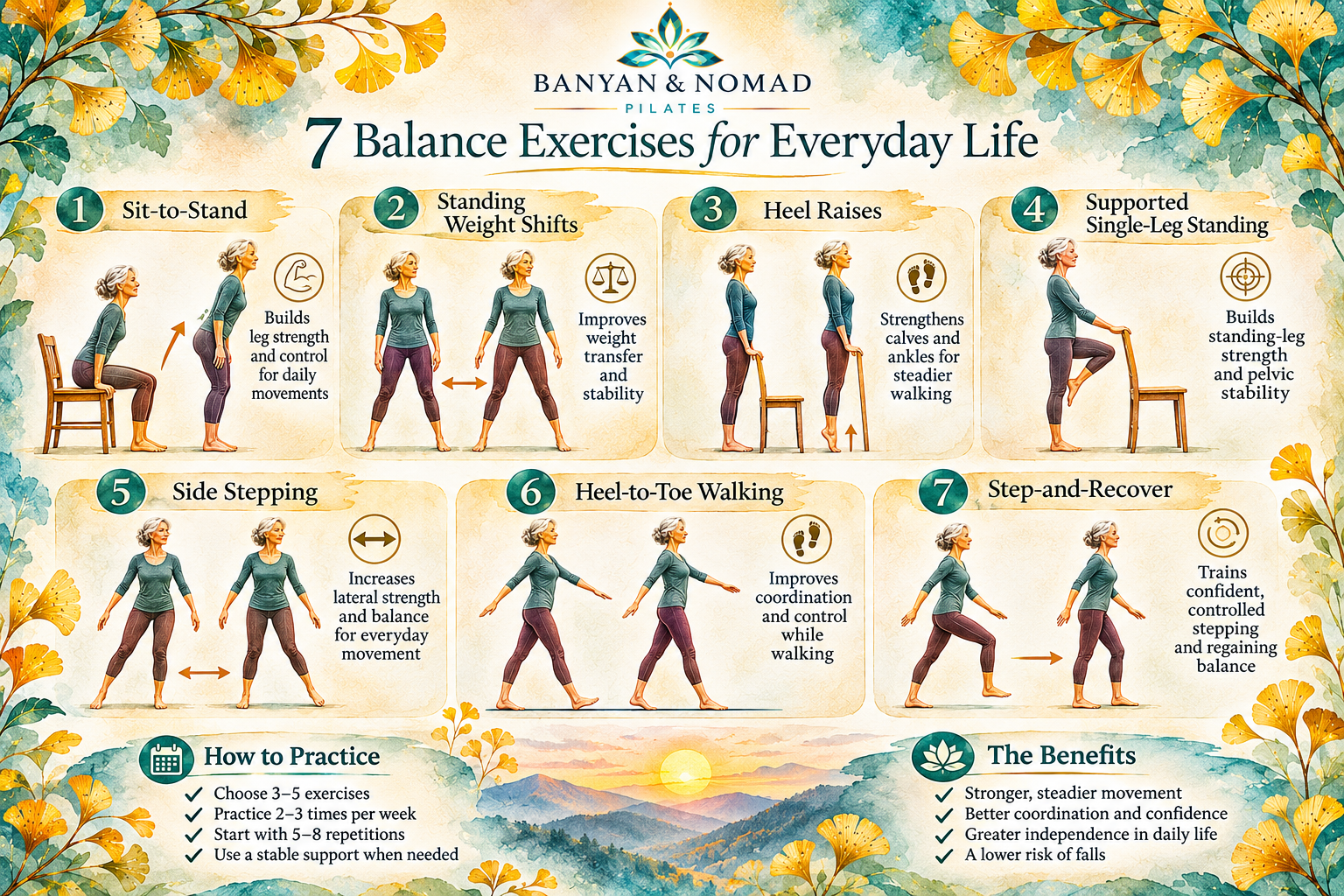
The following seven exercises are arranged from basic strength and weight control toward more demanding standing and walking activities. You don't have to master every exercise immediately, and you should always use a stable support when needed.
If you have recently fallen, experience unexplained dizziness, or have significant difficulty standing or walking, speak with an appropriate healthcare professional before beginning new balance challenges.
The 7 Exercises
Exercise 1: Sit-to-Stand
What it improves: Leg strength, functional mobility, and control during everyday transitions.
If I could choose one movement to demonstrate how closely exercise relates to daily life, Sit-to-Stand would be near the top of my list.
Every time we rise from a chair, we rely on our thighs, hips, and trunk to move our body upward while maintaining balance.
How to do it
Sit toward the front of a sturdy chair that won't slide or tip.
Place your feet approximately hip-width apart, with your heels comfortably beneath or slightly behind your knees.
Lean your torso forward slightly from the hips.
Press through your feet and stand up slowly.
Pause briefly, then lower yourself back into the chair with control.
Begin with five repetitions.
Try to avoid dropping into the chair during the final part of the movement. The controlled lowering is just as valuable as standing up.
Make it easier: Use a higher chair or push gently through the armrests. If necessary, have someone nearby to assist.
Make it more challenging: Reduce your reliance on your hands or slow the lowering phase, provided you can do so safely.
Notice this: Are you pushing more strongly through one leg? Does your weight shift to one side? Can you stand without rushing?
I often encourage people to think about the quality of this movement rather than how quickly they can complete ten repetitions. A slow, well-controlled rise can teach us more than several hurried ones.
Why it matters in daily life: Getting out of chairs, standing up from the sofa, and rising from the toilet.
Exercise 2: Standing Weight Shifts
What it improves: Weight transfer, hip stability, and awareness of your center of gravity.
Walking requires us to transfer our body weight repeatedly from one leg to the other.
Standing Weight Shifts allow us to practice that transfer without taking a step.
How to do it
Stand in front of a sturdy countertop, keeping your hands close to the surface for support.
Position your feet approximately hip-width apart.
Slowly move more of your weight onto your right foot.
Keep both feet on the floor as you feel the right leg accepting more weight.
Return to the center, then shift toward the left.
Repeat five to eight times in each direction.
Keep the movement small and controlled. Your shoulders and hips should remain relatively level.
Make it easier: Keep both hands resting on the countertop and use a smaller weight shift.
Make it more challenging: Gradually transfer more weight onto the supporting leg while keeping the other foot lightly touching the floor.
Notice this: Does one side feel more secure? Do you lean your shoulders rather than shifting your pelvis and body weight together?
This exercise may seem almost too simple, but it introduces a skill we use constantly. Before we can confidently step onto one leg, we need to become comfortable transferring weight onto it.
Why it matters in daily life: Walking, climbing stairs, stepping into trousers, and moving sideways around furniture.
Exercise 3: Heel Raises
What it improves: Calf strength, ankle control, and stability during walking.
Our ankles make small adjustments throughout the day, helping us maintain our position over our feet.
The calf muscles also contribute to walking and climbing stairs.
Heel Raises are a straightforward way to strengthen these muscles while practicing controlled movement.
How to do it
Stand facing a sturdy countertop with your feet approximately hip-width apart.
Rest your hands on the countertop for support.
Slowly lift both heels, rising onto the balls of your feet.
Pause briefly.
Lower your heels gently to the floor.
Begin with eight repetitions.
Avoid bouncing or pushing yourself upward too quickly. Try to distribute your weight evenly across the front of both feet.
Make it easier: Lift your heels only a small distance and keep both hands supported.
Make it more challenging: Increase the pause at the top or reduce hand pressure slightly, but only when your balance is secure.
Notice this: Do your ankles roll outward or inward? Does one heel rise higher than the other?
I like this exercise because it brings attention to a part of the body we often overlook. Stronger ankles alone won't solve every balance problem, but ankle strength and control contribute to steadier movement.
Why it matters in daily life: Walking, stepping forward, climbing stairs, and adjusting to small changes in the ground beneath your feet.
Exercise 4: Supported Single-Leg Standing
What it improves: Standing-leg strength, pelvic stability, and control when one foot leaves the ground.
We spend a surprising amount of time supported by one leg.
During walking, one foot is repeatedly lifted while the other supports the body. This makes single-leg control an important part of functional balance.
How to do it
Stand beside a sturdy countertop.
Place one or both hands on the surface.
Shift your weight onto your right leg.
Lift your left foot a few centimeters from the floor.
Hold for approximately five seconds, then lower it.
Repeat three times before changing sides.
If five seconds feels difficult, begin with two or three seconds.
Make it easier: Keep the toes of the lifted foot lightly touching the floor, or use both hands for support.
Make it more challenging: Gradually increase the duration to ten seconds or use a lighter handhold, without sacrificing stability.
Notice this: Does your supporting hip drop? Do you lean heavily to one side? Are you holding your breath?
I encourage people to resist the temptation to make this exercise more difficult simply by removing their hands. Support isn't cheating. It allows us to practice the movement safely while building the strength and control we need.
Why it matters in daily life: Walking, stepping into clothing, navigating stairs, and stepping over small obstacles.
Exercise 5: Side Stepping
What it improves: Lateral hip strength, coordination, and balance during sideways movement.
Most of our daily movement happens forward, but we also need to move sideways.
Think about stepping around an open cupboard door, making room for someone in a narrow hallway, or moving between furniture.
Side Stepping develops control in a direction that ordinary walking doesn't always challenge sufficiently.
How to do it
Stand facing a long, stable countertop.
Keep your knees relaxed and your feet pointing forward.
Step sideways with your right foot.
Bring your left foot toward it without rushing.
Continue for three or four steps, then reverse direction.
Repeat the sequence two or three times.
Try to keep your torso upright and avoid allowing your feet to cross.
Make it easier: Take smaller steps and maintain a comfortable handhold.
Make it more challenging: Increase the number of steps or introduce a brief pause before bringing the second foot across.
Notice this: Are you lifting your feet clearly or dragging them? Does your body lean excessively in the direction you're moving?
The goal is to make sideways movement deliberate and controlled.
Why it matters in daily life: Moving around furniture, navigating crowded spaces, and adjusting your position in the kitchen or bathroom.
Exercise 6: Heel-to-Toe Walking
What it improves: Dynamic balance, foot placement, and coordination.
This exercise introduces a narrower base of support, making it more challenging than ordinary walking.
It's also one of the exercises where I strongly recommend keeping a stable support nearby.
How to do it
Stand beside a long countertop or secure handrail.
Place one foot in front of the other, bringing the heel of the front foot close to the toes of the back foot.
Take a slow step forward.
Continue for three to five steps, keeping your hand close to or resting on the support.
Turn around carefully and repeat.
You don't need to place your feet in a perfectly straight line immediately.
Make it easier: Leave a small space between your feet or walk with them slightly farther apart.
Make it more challenging: Gradually narrow the space between your feet while maintaining access to support.
Notice this: Are you looking straight ahead or constantly down at your feet? Does your upper body become rigid?
I prefer that people develop confidence with a slightly wider foot position before attempting a narrow heel-to-toe pattern.
Why it matters in daily life: Walking through narrow spaces, navigating changes in direction, and controlling foot placement.
Exercise 7: Step-and-Recover
What it improves: Coordinated stepping, weight transfer, and returning to a stable standing position.
Our ability to take a controlled step and regain a comfortable stance is an important part of everyday balance.
This exercise practices deliberate stepping rather than attempting to reproduce a sudden loss of balance.
How to do it
Stand facing a sturdy countertop with both hands available for support.
Begin with your feet hip-width apart.
Take a small step forward with your right foot.
Transfer a comfortable amount of weight onto that foot.
Step back to your original position.
Repeat with your left foot.
Begin with five steps on each side.
Once forward stepping feels comfortable, you can practice small sideways steps using the same approach.
Make it easier: Keep your steps short and maintain both hands on the countertop.
Make it more challenging: Increase the step distance slightly or pause briefly before returning to your starting position.
Notice this: Can you place your foot where you intended? Do you return to a stable stance before beginning the next repetition?
This is one of my favorite exercises for connecting balance training with real movement. It requires us to organize the body, move our weight, and regain a comfortable position.
It isn't a substitute for supervised reactive-balance training, where people practice responding to unexpected disturbances under professional guidance.
Why it matters in daily life: Stepping around obstacles, changing direction, and adjusting your position while moving.
How to Turn These Exercises Into a Weekly Routine
You don't need to perform all seven exercises every day.
For someone new to balance training, I recommend beginning with a manageable selection and building consistency before increasing difficulty.
Here is one example of how to organize your practice.
Monday: Strength and Control
Allow approximately 10–15 minutes, including rests.
Sit-to-Stand: 5 repetitions
Heel Raises: 8 repetitions
Standing Weight Shifts: 5 per side
Supported Single-Leg Standing: 3 short holds per side
This session focuses on strengthening the legs and developing controlled weight transfer.
Wednesday: Movement and Coordination
Allow approximately 10–15 minutes, including rests.
Standing Weight Shifts: 5 per side
Side Stepping: 2–3 sequences in each direction
Heel-to-Toe Walking: 2–3 short passes
Step-and-Recover: 5 per side
This session introduces different directions of movement and more deliberate foot placement.
Friday: Putting It Together
Allow approximately 15–20 minutes, including rests.
Choose five of the seven exercises, beginning with those you find most manageable.
For example:
Sit-to-Stand
Heel Raises
Supported Single-Leg Standing
Side Stepping
Step-and-Recover
Finish by noticing which movements felt more comfortable than they did earlier in the week.
This is a sample routine rather than a universal prescription. The exercises should be adjusted to your physical abilities, and people at higher risk of falling may benefit from a supervised, individualized program.
As your confidence improves, you can gradually increase repetitions, duration, or movement complexity. You may also include short, supported balance practices on other days.
Three Mistakes That Can Make Balance Training Less Effective
1. Making Exercises Too Difficult Too Soon
There's a common assumption that a balance exercise is only effective if it makes you wobble.
That's not how I approach training.
A useful exercise should provide an appropriate challenge while allowing you to maintain enough control to practice safely.
If you're constantly grabbing for support, holding your breath, or feeling frightened, the exercise may be too difficult for your current ability.
It's better to reduce the challenge and gradually build from there.
2. Practicing Only While Standing Still
Standing balance is important, but daily life requires movement.
We need to step forward, move sideways, turn, reach, and transfer our weight.
A balanced exercise routine should include both stationary positions and controlled movement.
This is one reason I like to combine exercises such as Supported Single-Leg Standing with Side Stepping and Step-and-Recover.
3. Forgetting About Strength
Balance and strength are closely connected.
If the muscles around the hips, thighs, and ankles aren't strong enough to support a movement, maintaining control becomes more difficult.
This is why I include exercises such as Sit-to-Stand and Heel Raises rather than concentrating entirely on balancing positions.
The goal isn't simply to become better at balance exercises. It's to develop physical abilities that make everyday movement more manageable.
What Should You Notice After Four Weeks of Balance Training?
After several weeks of consistent practice, you may begin to notice improvements in familiar movements.
Perhaps you can rise from a chair more smoothly, stand on one leg with less reliance on your hands, or complete a short sequence of sideways steps with better coordination.
These changes may be subtle.
I encourage people to pay attention to how a movement feels rather than expecting dramatic results after a particular number of days.
A useful way to observe progress is to repeat the same simple exercises under similar conditions.
For example, record how many controlled Sit-to-Stand repetitions you can perform comfortably, how long you can maintain a supported single-leg position, or how smoothly you can complete a short Side Stepping sequence.
Compare your observations after two or four weeks.
Try not to turn this into a competition with yourself. Balance can fluctuate depending on fatigue, sleep, medication, illness, and other factors.
The important question is whether your overall movement is becoming more controlled and comfortable.
When Should You Seek Professional Help for Balance Problems?
Exercise can help many people improve strength and balance, but not every balance problem is caused by weakness or lack of practice.
Vision changes, inner-ear disorders, neurological conditions, medication effects, and other medical issues can contribute to unsteadiness.
If you experience repeated falls, new balance difficulties, persistent dizziness, or a noticeable change in walking, it's important to seek medical assessment.
Sudden severe balance problems, particularly when accompanied by weakness, difficulty speaking, facial drooping, or other neurological symptoms, require emergency medical attention.
For people with significant balance limitations, a physical therapist can help identify appropriate exercises and assess whether additional treatment is needed.
There is no benefit in pushing through symptoms that may indicate a medical problem.
Balance Is Something We Practice for Life
I don't think balance training should be approached as a temporary project that we complete and then forget.
It's part of caring for our ability to move independently and participate in the activities we enjoy.
Some days, that might mean practicing a few controlled movements beside the kitchen counter. On other days, it could involve a longer session combining Pilates, strength, coordination, and mindful movement.
The important thing is to keep moving in ways that are appropriate for your body.
We don't need perfect balance to begin improving it. We need a sensible starting point, a willingness to practice, and enough patience to recognize progress as it develops.
And perhaps the most encouraging part is that the exercises that help us feel steadier don't have to be complicated.
Often, the movements that make the greatest difference are the ones that prepare us for the ordinary moments of everyday life.
Coming Soon: The Balance Program
If you're ready to take your balance practice further, I'm excited to share that The Balance Program will soon be launching on Podia.
This eight-week program brings together Pilates, strength training, balance exercises, coordination, mindful movement, and restorative practices in a structured progression.
Rather than repeating the same exercises week after week, we'll gradually build on familiar movements, introduce new challenges, and explore how different aspects of movement work together.
I've designed the program to provide a thoughtful, accessible way to make balance and mobility a regular part of your life.
Special introductory pricing will be available when The Balance Program launches, so keep an eye out for the announcement.
I'd love to help you discover how much more confident and comfortable movement can become with consistent, purposeful practice.
With mindfulness,
Elena
Research & Further Reading
Sherrington et al. (2019). Exercise for preventing falls in older people living in the community. Cochrane Database of Systematic Reviews.
https://doi.org/10.1002/14651858.CD012424.pub2World Health Organization (2020). WHO Guidelines on Physical Activity and Sedentary Behaviour. Recommendations for older adults, including multicomponent physical activity emphasizing functional balance and strength.
https://www.who.int/publications/i/item/9789240015128Centers for Disease Control and Prevention. Physical Activity Guidelines for Older Adults. Recommendations for aerobic activity, muscle strengthening, and balance training.
https://www.cdc.gov/physical-activity-basics/adding-older-adults/index.htmlNational Institute on Aging. Exercise and Physical Activity: Your Everyday Guide. Practical guidance on strength, balance, endurance, and flexibility exercises.
https://order.nia.nih.gov/publication/exercise-and-physical-activity-your-everyday-guide-from-the-national-institute-on-agingU.S. Preventive Services Task Force (2024). Falls Prevention in Community-Dwelling Older Adults: Interventions. Recommendations supporting exercise interventions for selected older adults at increased risk of falls.
https://www.uspreventiveservicestaskforce.org/uspstf/recommendation/falls-prevention-community-dwelling-older-adults-interventions