
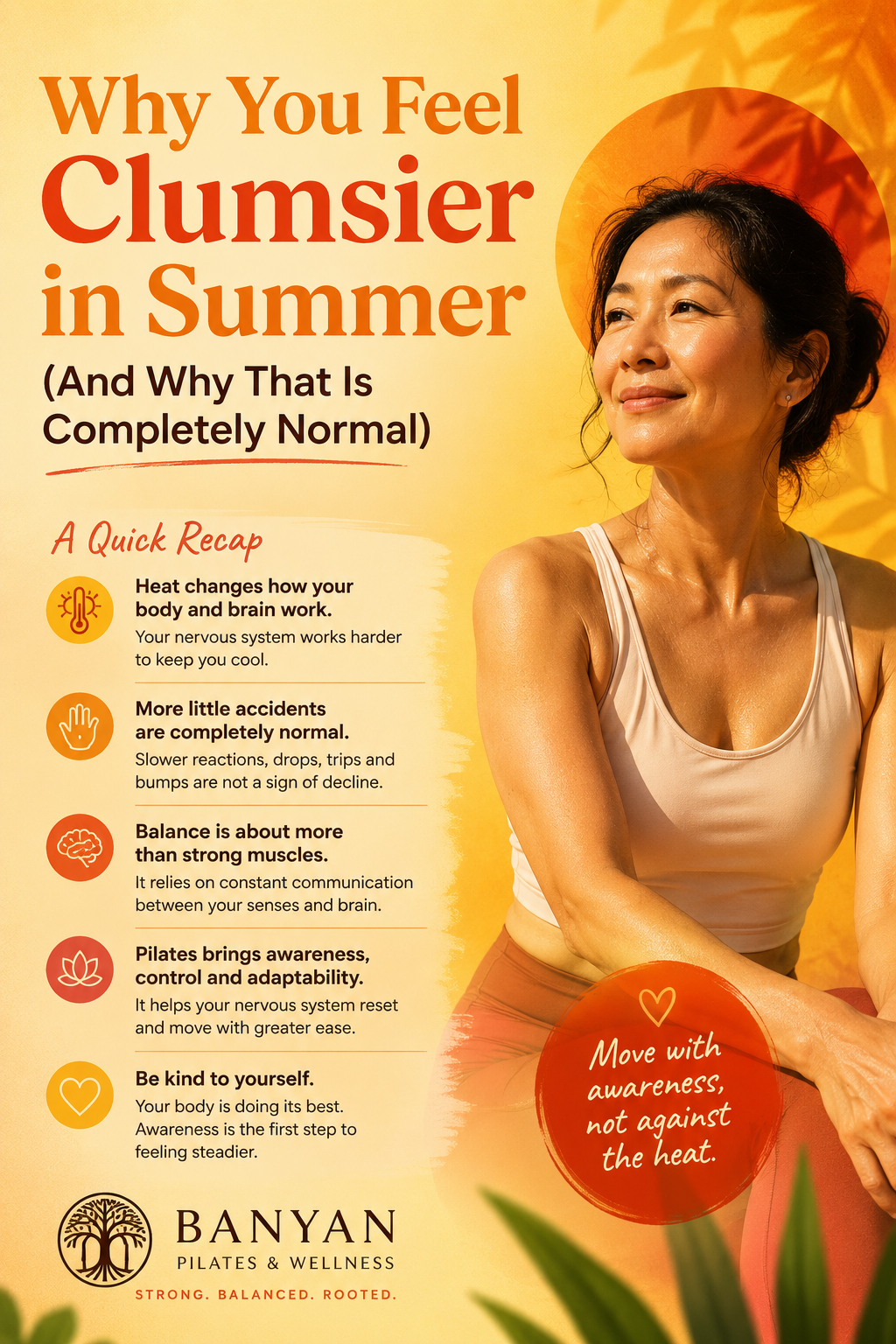
Why You Feel Clumsier in Summer (And Why That Is Completely Normal)
Have you ever noticed that during the hottest weeks of summer you seem to drop your keys more often, bump into the corner of the coffee table, miss a step on the stairs, or lose your train of thought halfway through a conversation? Most people blame themselves. They assume they are distracted, getting older, or simply having an "off" day. In reality, there is something much more interesting happening.
Hot weather changes the way your entire body operates. Your heart works harder to cool you down, your blood vessels widen, you lose fluids faster, and your nervous system has to constantly adjust to keep everything functioning smoothly. Even if you are healthy, hydrated, and active, these subtle changes can affect your coordination, reaction time, concentration, and sense of balance far more than you might expect.
This doesn't mean something is wrong with you. It means your body is adapting to an environment that requires extra work behind the scenes. The more you understand those adaptations, the easier it becomes to move with your body instead of becoming frustrated by it. That is one of the reasons Pilates becomes especially valuable during the summer months. Rather than demanding more from an already busy nervous system, it helps restore efficiency, awareness, and control.
Your Brain Is Working Overtime to Keep You Cool
When temperatures climb, your body immediately shifts its priorities. Cooling itself becomes one of the most important tasks of the day. Blood flow is redirected toward your skin, sweating increases, your heart pumps faster, and your nervous system constantly monitors temperature while trying to maintain normal function everywhere else. None of this happens consciously, yet it requires an enormous amount of energy.
Because so many internal resources are devoted to regulating temperature, other processes can become just a little less efficient. Your reactions may feel slower. You may hesitate before catching something that slips from your hands. You may need an extra second to regain your footing after turning quickly. These aren't dramatic failures of balance. They are tiny adjustments happening inside a nervous system that is already managing an increased workload. Once you understand this, those small moments of clumsiness become much easier to interpret without immediately assuming something is wrong.
The Little Accidents That Suddenly Seem to Happen Everywhere
Summer often comes with stories that sound surprisingly familiar. Someone trips over an uneven sidewalk they have walked across hundreds of times. Another person drops their phone while taking it out of a bag. A glass slips from damp hands. Someone misses the last step on a staircase or walks into a doorframe that has always been there. Individually, these moments seem random. Together, they tell a different story.
Attention is not an unlimited resource. Heat, dehydration, poor sleep, longer daylight hours, busy vacation schedules, and physical fatigue all compete for it. Your brain begins filtering information differently, sometimes sacrificing precision for efficiency. That split-second delay between seeing, processing, and reacting can be enough to make everyday movements feel slightly less coordinated. It isn't carelessness. It is often a nervous system doing its best while operating under more demanding conditions than usual.
Why Balance Depends on More Than Strong Muscles
Many people think balance is simply about leg strength or core stability. Those things certainly help, but true balance begins much deeper. It depends on constant communication between your eyes, your inner ear, your joints, your muscles, and your brain. Every second, these systems exchange thousands of tiny pieces of information to determine where your body is in space and what adjustments need to happen before you even realize they are necessary.

Heat can influence this communication in subtle ways. Fatigue changes the quality of muscle contractions. Mild dehydration affects circulation. Reduced concentration makes it easier to miss important sensory information. Even your breathing pattern may become shallower as your body works to regulate temperature. None of these changes automatically cause falls or injuries, but together they can make movement feel less precise. That is why balance should never be viewed as something you either have or lose. It is a conversation happening throughout your entire body, and summer simply changes the volume of that conversation.
Pilates Helps Your Nervous System Find Its Way Back
One of the reasons I continue to recommend Pilates throughout the summer is because it asks something very different of your body than many forms of exercise. Instead of encouraging you to push harder despite the heat, Pilates invites you to slow down enough to notice what your body is actually experiencing. You begin paying attention to how your feet meet the floor, how your breath supports movement, how your spine organizes itself, and how your balance shifts with every change in position.
This kind of mindful movement trains the nervous system as much as it trains the muscles. It sharpens body awareness, improves coordination, and strengthens the communication between all the systems responsible for balance. Perhaps even more importantly, it teaches you to adapt. On a particularly hot day, success is not measured by doing more repetitions or increasing intensity. It is measured by moving with greater clarity, better control, and deeper awareness. Those are the qualities that carry over into daily life, making you feel steadier whether you are climbing stairs, walking outdoors, or simply carrying groceries home.
If you have felt a little slower, a little less coordinated, or just slightly more clumsy this summer, try replacing self-criticism with curiosity. Your body may simply be responding exactly as it was designed to respond under challenging conditions. Rather than fighting those changes, learn to understand them. The better you work with your nervous system, the more confidently it will work for you.
With mindfulness,
Elena