
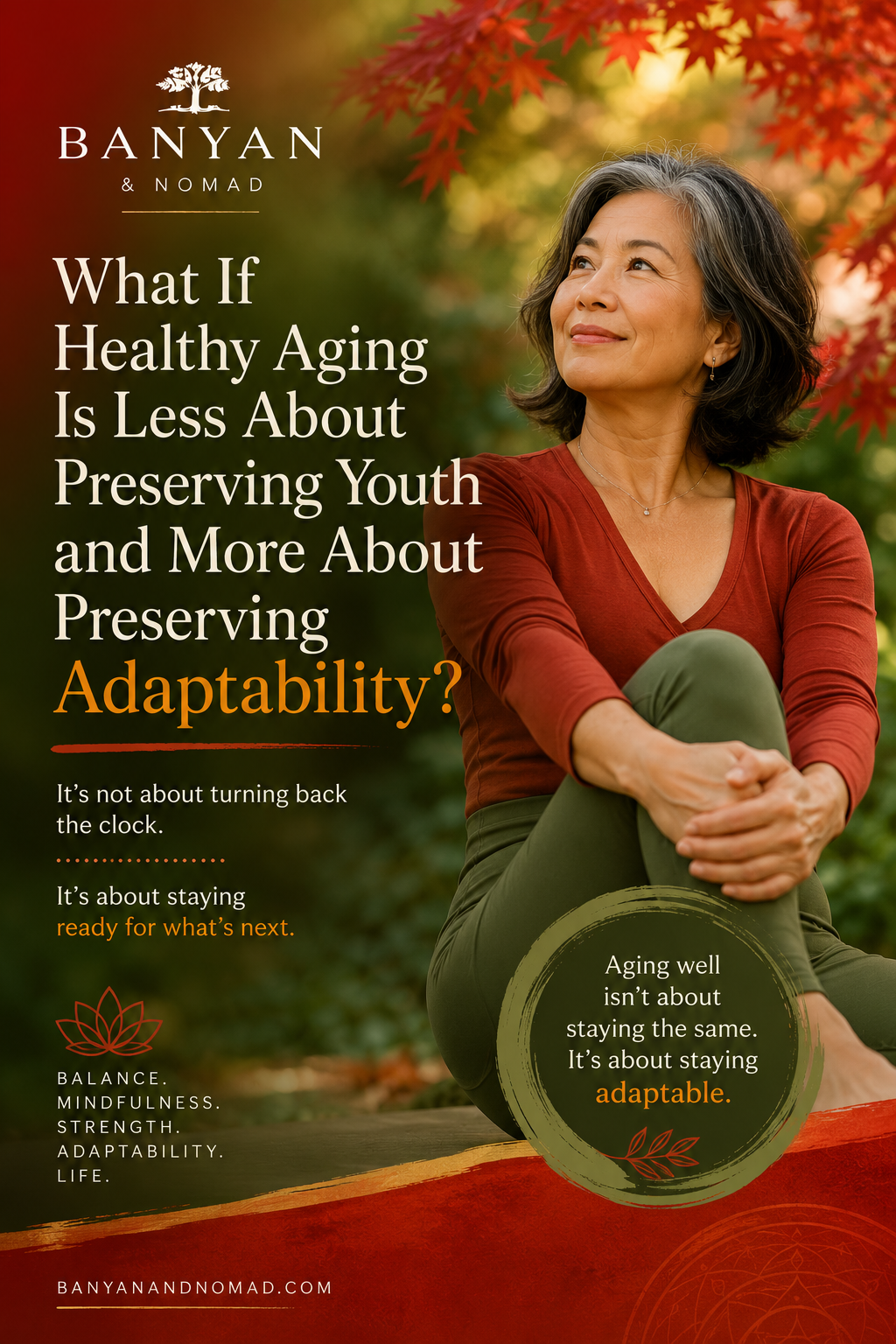
What If Healthy Aging Is Less About Preserving Youth and More About Preserving Adaptability?
We have spent decades talking about healthy aging as though the goal were to hold on to an earlier version of ourselves for as long as possible. We praise people for “looking young,” celebrate bodies that appear to defy age, and often approach exercise as a way of fighting an inevitable decline. I have never found that particularly helpful, either as a way of thinking about aging or as a way of working with the people I teach. A 70-year-old body does not need to prove that it can impersonate a 30-year-old body. What matters much more to me is what that person can still do when life changes the question. Can you recover when you lose your balance? Can you learn a movement you haven't done before? Can you walk while carrying something and talking to the person beside you? Can your body adjust when the pavement becomes uneven, when you have to turn quickly, when you're tired, or when you suddenly have to step around something? Can you recognize when stress has changed your breathing and bring yourself back? Increasingly, the science of healthy aging is moving toward a similarly broader idea. The World Health Organization describes healthy aging in terms of functional ability, supported by what it calls intrinsic capacity, which includes locomotion, cognition, sensory abilities, psychological capacity and vitality. Recent research is also examining resilience, cognitive-motor training and the different trajectories these capacities can take as we grow older. In other words, perhaps the more useful question isn't, How much youth can I preserve? Perhaps it is, How much capacity to respond, learn and adapt can I preserve?
Aging Is Not One Thing Happening to the Whole Body at Once
One of the ideas I wish we could retire is that age works like a single dial that someone turns down a little every birthday. Human beings simply don't age that neatly. Strength can change without balance changing at exactly the same rate. Vision may change while mobility remains excellent. Someone can have extraordinary endurance but become less confident stepping backward. Another person may not be particularly strong and yet remain remarkably coordinated and agile. Cognitive ability, sensory function, psychological health, vitality and locomotion interact, but they aren't interchangeable. This is reflected in the WHO concept of intrinsic capacity, which deliberately looks across several physical and mental domains rather than defining healthy aging by the absence of disease or by one fitness measurement. Research following these capacities over time is finding different aging trajectories rather than one universal path. A 2025 longitudinal study, for example, identified distinct patterns of intrinsic-capacity change and found that poorer trajectories were associated with greater functional limitations and lower quality of life.
There is another finding I find especially encouraging because it challenges the fatalism that often surrounds aging. Research comparing generations in England and China found that more recent cohorts were entering older age with higher overall levels of capacity than earlier generations, with particularly notable differences in cognition, locomotion and vitality. That doesn't mean aging has somehow been abolished, nor does it mean everyone has equal opportunities to age well. It does tell us that chronological age alone is a surprisingly poor description of what a person can do. The WHO makes the same point very clearly: there is no single “typical” older person, and people of the same chronological age can have dramatically different levels of physical and mental capacity. For me, this matters enormously. If aging were simply a countdown controlled by the calendar, there wouldn't be much for us to work with. But if function is influenced by multiple capacities, our environment, our experiences and what we continue to practice, then the conversation becomes much more interesting.
Balance Is Really an Exercise in Adaptation
When people hear the word balance, they often picture someone standing perfectly still on one leg. That's useful as an exercise or assessment, but it isn't how balance usually works in life. Real balance is messy. You step onto grass that is softer than you expected. Someone bumps into you in a crowded store. You turn your head because somebody calls your name. You carry two grocery bags up a step. Your dog suddenly changes direction. You're walking through an airport while looking for a gate number and listening to your travel companion at the same time. Your nervous system is continuously integrating information from vision, the vestibular system and sensory receptors throughout the body, while coordinating muscular responses and making rapid adjustments. Being balanced doesn't mean never wobbling. Often, it means being able to respond effectively when the wobble arrives.
This is one reason research into dual-task training has become so interesting. Scientists increasingly study what happens when older adults perform a movement or balance task while simultaneously doing something cognitive, because that resembles ordinary life much more closely than performing one isolated task in a quiet room. A 2024 systematic review and meta-analysis found that dual-task training improved balance in healthy older adults, and more recent reviews continue to investigate combinations of cognitive and physical tasks for balance, gait and cognitive function. I find the principle behind this particularly valuable: we don't only want a body that can succeed when conditions are perfect. We want a system capable of reorganizing when conditions aren't perfect. That is a very different definition of balance, and it changes the way I think about training it.
Strength Matters, but Strength Without Options Isn't Enough
Please don't misunderstand me: strength is enormously important as we age. We need muscle to rise from a chair, climb stairs, carry groceries, support our joints and respond when we stumble. But I don't want strength to become the latest single answer to an extremely complex question. You can strengthen the legs and still avoid turning quickly. You can have strong abdominal muscles and become uncomfortable when you close your eyes during a balance exercise. You can perform the same exercise beautifully in a studio and feel surprisingly uncertain on a rocky path. Human movement depends on much more than the amount of force a muscle can produce. It also depends on coordination, sensory information, timing, attention, previous experience and confidence.
This is where I think Pilates can offer something particularly valuable when it is taught thoughtfully. I am not interested in having someone simply reproduce a perfect-looking movement. I want them to notice what happens when the position changes, when the resistance changes, when an arm and a leg have different jobs, when breathing is incorporated, or when a familiar exercise receives a small variation. Can you organize yourself again? Can you learn? Can you make an adjustment without becoming frightened by the fact that the first attempt wasn't perfect? That process matters. Recent healthy-aging research increasingly treats locomotion alongside cognition, sensory ability, psychological capacity and vitality rather than pretending any one system operates alone. A 2025 meta-analysis involving more than 53,000 participants found that declines across several intrinsic-capacity domains were associated with later functional impairment, with locomotion emerging as particularly important. To me, that reinforces something I see in practice: maintaining function isn't about collecting isolated physical achievements. It is about keeping enough of the whole system available to meet the demands of life.
Mindfulness May Be One of the Ways We Notice Change Early
Mindfulness may seem like an unusual subject to bring into a discussion about physical adaptability, but for me the connection is quite direct. You can't respond intelligently to information you aren't noticing. When I teach mindfulness, I'm not trying to make someone permanently serene or teach them to float through life unaffected by stress. I'm interested in awareness. Can you recognize that you've stopped breathing freely because you're concentrating? Can you notice that you've become tense before that tension has accompanied you for six hours? Can you feel the difference between genuine pain and the unfamiliarity of a new movement? Can you recognize fatigue and adjust rather than simply pushing harder or giving up completely? These are small acts of attention, but they change the quality of the choices we make.
I see this in movement sessions as well. A person who is paying attention begins to gather information about themselves. They notice that one foot is doing something different from the other. They discover that balance changes when they look away. They realize they're holding their breath during the difficult part of an exercise. They notice that they can actually perform a movement they had already decided was “too hard for someone my age.” Mindfulness doesn't magically prevent physical aging, and I would never want to make that claim. What it can offer is a different relationship with change. Instead of noticing our bodies only when something hurts or fails, we become more attentive to the quieter information that arrives every day. That awareness gives us an opportunity to respond sooner, experiment, modify, seek help when necessary and continue learning. In a conversation about adaptability, I think that matters tremendously.
Maybe the Goal Is to Build a Body and Brain That Can Meet the Unexpected
The emerging idea of resilience in aging takes us even closer to this way of thinking. In gerontology, resilience isn't simply a personality trait or a positive attitude. Researchers are interested in the capacity to adapt and recover when the system encounters a stressor, and that can involve physical, cognitive and psychosocial dimensions. A 2025 review described resilience in older adults in relation to reserve, adaptation, independence and quality of life. I find that much more useful than the language of “anti-aging.” Anti-aging asks us to resist time. Resilience asks what resources we have when something changes. Those are profoundly different questions.
And life will change the conditions. We will have tired days. We will encounter unfamiliar stairs, slippery sidewalks, illnesses, stressful weeks, new environments and periods when our normal routines disappear. Sometimes we'll have to learn something completely new at an age when the culture has already started suggesting that learning new physical skills isn't for us anymore. I don't think successful aging means eliminating all of those challenges, and it certainly doesn't mean never needing help. I think it means preserving as many options as we reasonably can. Strength gives us options. Balance gives us options. Mobility gives us options. Sensory awareness gives us options. Cognitive flexibility gives us options. Mindfulness helps us notice which option the moment requires. And confidence allows us to use those capacities instead of gradually shrinking our lives because something might be difficult.
Here's My Final Thought
If you're thinking about how you want to age, I would encourage you to ask yourself something different from How do I stay young?
Ask: How do I stay adaptable?
Can I still learn a new movement?
Can I recover when I lose my balance?
Can I move confidently when the environment changes?
Can I notice when my body is asking me to change my approach?
Can I challenge myself without demanding perfection?
Can I remain curious about what my body can learn rather than constantly measuring it against what it could do twenty years ago?
I don't want my clients to spend the second half of their lives trying to preserve themselves like photographs. I want them to remain participants in their own lives, capable of responding when the next moment asks for something slightly different from the last.
Perhaps that is a more generous definition of healthy aging.
Not remaining unchanged.
Remaining able to change.
With mindfulness,
Elena