
Wellness Culture Has Made Ordinary Human Emotions Feel Like Symptoms
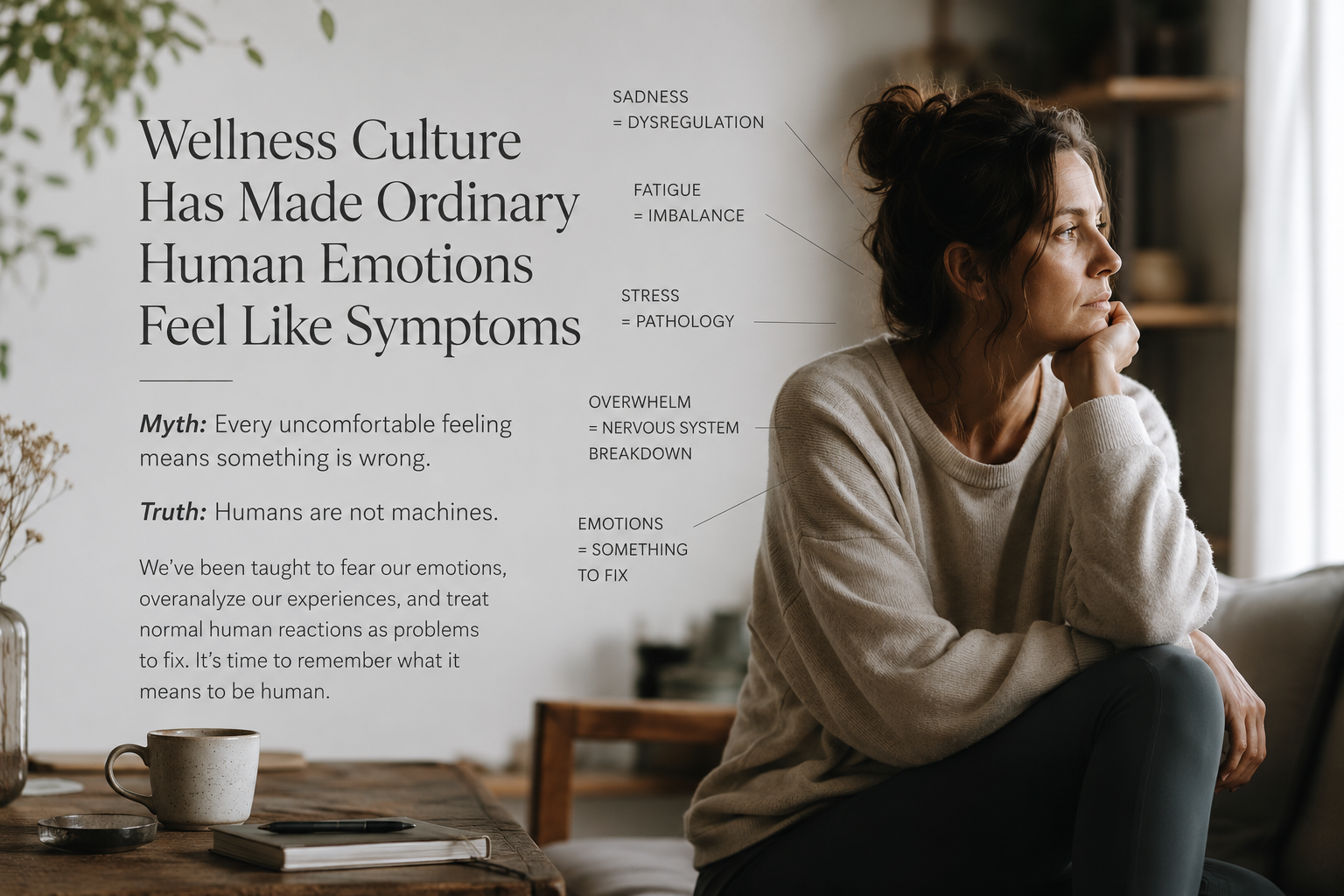
Somewhere along the way, wellness culture quietly changed the meaning of being human. Feeling tired stopped being a natural response to stress, grief, overwork, parenting, poor sleep, or simply being alive. Sadness became a sign that something was dysregulated. Anxiety became proof that the nervous system was broken. A difficult week suddenly required a diagnosis, a protocol, a supplement routine, or a complete lifestyle overhaul.
I see this constantly now. People arrive deeply frightened by experiences that are often completely human. They no longer trust ordinary emotional fluctuations because they have spent years consuming content that teaches them to scan every sensation and every feeling for signs that something is wrong. The result is not greater self-awareness. The result is fear. And fear has become one of the wellness industry's most profitable products.
Sadness Is Not Automatically Dysregulation
There is a strange pressure now to recover from sadness almost immediately, as if emotional discomfort has become a problem that needs solving rather than an experience that needs living through. People become afraid the moment sadness lasts longer than expected. They begin searching for explanations, systems, protocols, nervous system language, and hidden meanings because remaining sad for a period of time feels unacceptable.
But sadness is not always dysfunction. Sometimes sadness means loss happened. Sometimes disappointment happened. Sometimes something important ended. Sometimes your body and mind are responding exactly as they should. Grief, heartbreak, transitions, loneliness, and change are not design flaws. Human beings are not built to remain emotionally flat and emotionally optimized every day of their lives.
Sadness becomes dangerous when people start fighting it before understanding it. They become so focused on escaping the feeling that they never ask what it might be asking for. Not every difficult emotion requires intervention. Sometimes it requires space.
And I think this is one of the biggest misunderstandings I see today. People are terrified of normal emotional pain because they have been taught that every uncomfortable state is evidence that something inside them is malfunctioning.
Myth: Fatigue Means Something Is Wrong
Truth: Sometimes You’re Just Human
Modern wellness culture has created an environment where people are deeply suspicious of fatigue. The moment energy drops, people immediately assume something is broken. Hormones. Adrenals. Inflammation. Deficiency. Nervous system collapse. Suddenly a completely understandable response to life becomes a medical mystery.
But exhaustion is not always pathology. Sometimes you worked too much. Sometimes you slept badly for several nights. Sometimes your child kept you awake. Sometimes you moved homes, experienced grief, traveled, cared for others, managed stress, or simply carried too much for too long.
Humans are not designed to operate with endless consistency. We are biological systems, not machines with identical outputs every day. There are seasons in the body. There are seasons in energy. And there are days where the body asks for less, not because it is broken, but because it is adapting.
What worries me is how quickly ordinary fatigue now creates panic. Instead of asking, "What have I been carrying lately?" people ask, "What is wrong with me?" Those are very different questions.
Stress Has Become the Villain in Every Story
If you spend enough time online, you eventually start believing stress is one of the most dangerous experiences a human being can have. Stress has become the explanation for everything and the enemy of everything. People speak about it as if any rise in discomfort or challenge is immediately harmful.
But stress itself is not the problem. Human beings were built for stress. The body adapts through challenge. Muscles strengthen through stress. Bones strengthen through stress. Balance improves through stress. Resilience develops through stress.
The issue is not stress itself. The issue is chronic overload without recovery, reflection, or support.
And yet wellness culture often treats all forms of stress as equally dangerous. It does not distinguish between challenge and threat. Between effort and overwhelm. Between adaptation and depletion. The result is people becoming frightened of experiences that once simply belonged to ordinary life.
Myth: Emotional Discomfort Means You Need to Fix Something
Truth: Sometimes You Need to Feel It
There is now tremendous pressure to optimize emotional life. Every uncomfortable feeling immediately becomes a project. A podcast to listen to. A routine to create. A nervous system intervention. A self-help strategy.
The problem with constantly fixing yourself is that eventually you stop experiencing emotions naturally. Everything becomes a problem-solving exercise.
There are moments in life where sadness should feel sad. Grief should feel heavy. Uncertainty should feel uncertain. If every difficult emotion immediately activates a fixing response, people lose trust in their ability to simply survive their own feelings.
Not every emotional state requires management. Some emotions simply need enough space to complete themselves.
Wellness Language Is Starting to Pathologize Daily Life
People now casually describe themselves as dysregulated, inflamed, triggered, depleted, burned out, activated, disconnected, and imbalanced after ordinary difficult days. Language that once served useful clinical or therapeutic purposes is now being used constantly and often without context.
Words matter because they shape perception. When every difficult feeling becomes clinical language, people start relating to themselves as fragile systems constantly on the edge of malfunction.
I worry about this deeply because language changes behavior. If people repeatedly hear that ordinary emotional fluctuations signal dysfunction, they begin monitoring themselves more aggressively. And excessive self-monitoring rarely creates peace.
It creates fear.
We Are Becoming Experts at Monitoring and Beginners at Living
People know more than ever about nervous systems, trauma responses, stress physiology, and emotional regulation. Yet many seem more afraid of their internal experience than ever before.
They constantly scan for signs that something is wrong. They monitor energy levels, emotional shifts, mood fluctuations, and body sensations with exhausting precision.
Awareness is important. Hypervigilance is different.
Real mindfulness is not obsessive monitoring. Real mindfulness allows room for uncertainty, complexity, fluctuation, and humanity.
Humans Were Never Supposed to Feel Good All the Time
Perhaps the most dangerous idea hidden inside wellness culture is the assumption that health should feel consistently good. People quietly absorb the idea that if they are doing everything correctly, they should feel calm, energized, emotionally balanced, productive, grateful, and regulated most of the time.
That expectation alone creates suffering.
Human life includes stress, grief, boredom, confusion, irritation, fatigue, emotional messiness, and periods of uncertainty. Not because we are failing, but because we are alive.
🌿 Here’s my final tip
The next time you feel something difficult, resist asking, "What is wrong with me?" Ask something harder: "Could this simply be part of being human?"
You might be surprised by how much relief exists inside that question.
Mantra: “I do not treat every feeling like a symptom.”
With mindfulness,
Elena