
We Have Turned Exhaustion Into a Personality Trait
There was a time when being tired was considered a signal.
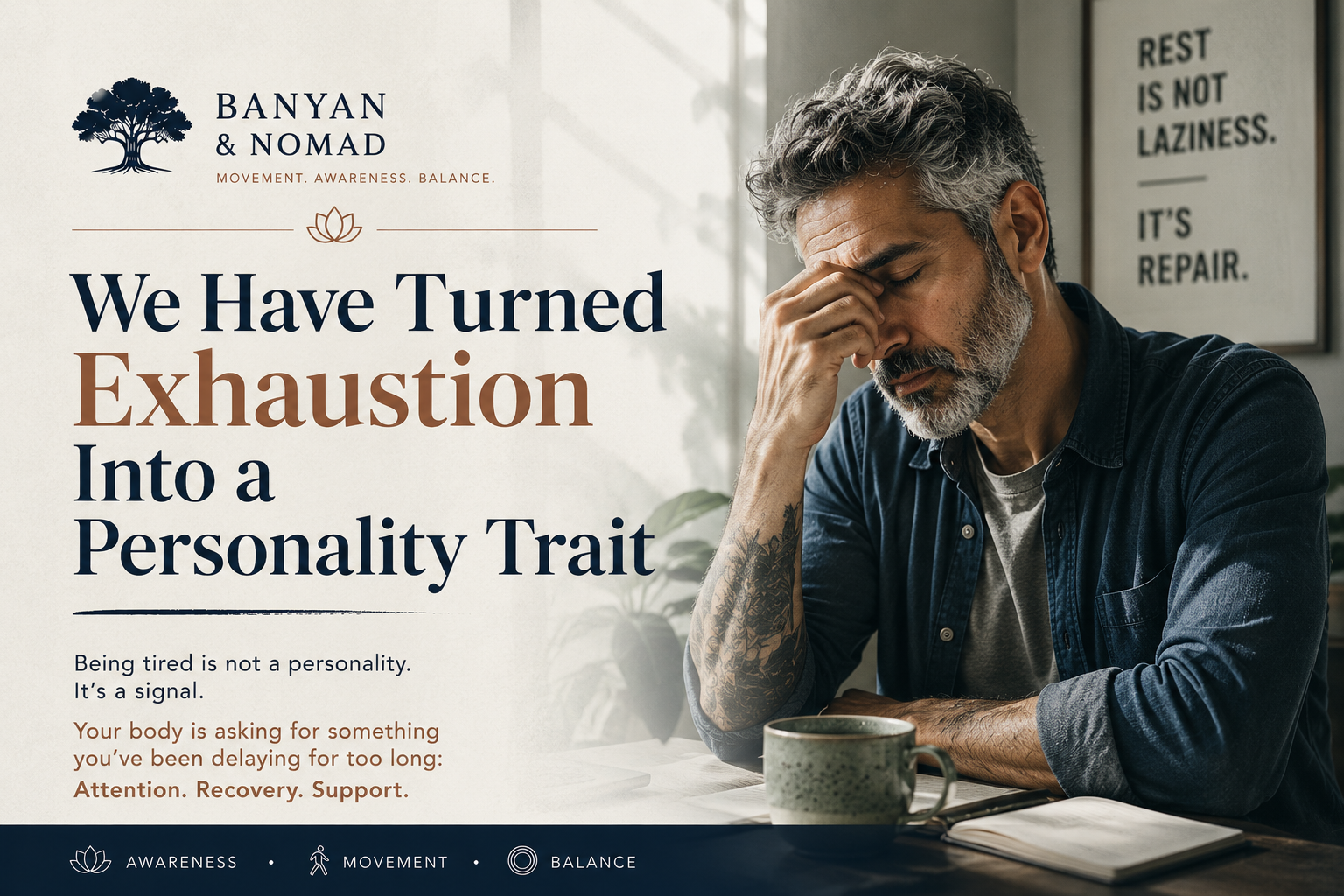
Today, it has become a badge of honor.
I hear it almost every day. People introduce themselves through their exhaustion. They tell me they are busy. Overwhelmed. Running on four hours of sleep. Constantly multitasking. They say it with a laugh, sometimes even with a hint of pride. Somewhere along the way, we started treating depletion as evidence of commitment. If you're exhausted, you must be working hard. If you're overwhelmed, you must be important. If you're constantly busy, you must be successful.
The problem is that the body does not care about cultural trends.
The nervous system does not interpret exhaustion as achievement. It interprets it as stress. It interprets it as a need for recovery. It interprets it as a signal that resources are being consumed faster than they are being replenished. Yet many people continue pushing forward, convinced that feeling depleted is simply part of modern life. In my work, I see the consequences of this every day. People arrive wanting to improve balance, mobility, confidence, or physical function, but beneath those goals there is often something much deeper. Their bodies are exhausted. Not because they are weak. Not because they lack motivation. Because they have been operating in survival mode for far too long.
We Celebrate Exhaustion and Then Wonder Why We Feel Unwell
Imagine if someone proudly announced that they hadn't drunk water for three days.
Most people would be concerned.
Yet when someone says they worked all weekend, slept five hours a night, skipped exercise, answered emails at midnight, and haven't had a real break in months, we often admire their dedication. This contradiction has become deeply embedded in modern culture. According to the World Health Organization, workplace burnout has become such a widespread issue that it is now recognized as an occupational phenomenon. Research consistently links chronic overwork and insufficient recovery to increased risks of cardiovascular disease, depression, anxiety disorders, metabolic dysfunction, and impaired immune function.
What concerns me most is not that people are tired. It is that many no longer recognize exhaustion as a problem. The body is remarkably adaptable. It can normalize almost anything. Chronic tension becomes normal. Poor sleep becomes normal. Mental fog becomes normal. A constant feeling of rushing becomes normal. Over time, many people stop asking whether something is wrong because they assume everyone feels this way. In reality, what they have adapted to may be quietly affecting every system in the body.
The Nervous System Was Never Designed for This
Human beings evolved in environments where stress came in waves.
A threat appeared. The body responded. The threat passed. Recovery followed.
Today's stress rarely works that way.
Instead, many people experience low-level activation throughout the day. Notifications arrive before breakfast. News headlines trigger concern. Work follows us home through phones and laptops. Financial pressures linger in the background. Family responsibilities continue long after the workday ends. The body receives signal after signal that something requires attention. The result is not necessarily panic. More often, it is a subtle but persistent state of vigilance.
Research from neuroscience and psychophysiology shows that chronic activation of the stress response can influence memory, concentration, decision-making, digestion, inflammation, and sleep quality. Elevated cortisol levels over extended periods have been associated with increased health risks across multiple body systems. This does not mean stress is inherently harmful. Stress is necessary. The problem arises when recovery becomes optional instead of essential. The nervous system is built to handle challenges. It is not built to operate at maximum capacity indefinitely.
Being Busy Is Not the Same as Being Productive
One of the most common misconceptions I encounter is the idea that constant activity equals effectiveness.
In reality, cognitive performance begins to decline long before most people notice. Studies have shown that sleep deprivation can impair attention, reaction time, judgment, and decision-making to a degree comparable to alcohol intoxication. Yet many people continue making important decisions while chronically fatigued. They push through meetings. They drive while distracted. They navigate daily responsibilities while operating with significantly reduced mental resources.
I often remind clients that the goal is not to do less. The goal is to function better. There is a difference. A rested brain processes information more efficiently. A regulated nervous system makes better decisions. A body that has recovered moves with greater confidence and stability. Productivity is not measured by how exhausted you are at the end of the day. True effectiveness often comes from having enough energy left to engage fully with what matters most.
Your Body Is Keeping a Record
The body has an extraordinary memory.
Even when the mind adapts to chronic stress, the body continues recording the experience. Tight shoulders, jaw clenching, disrupted breathing patterns, poor balance, muscle tension, digestive discomfort, headaches, and fatigue are often not isolated problems. They are pieces of a larger story. In many sessions, clients tell me they feel disconnected from their bodies. Then we begin moving. We notice posture. We notice breath. We notice how weight shifts through the feet. Suddenly patterns emerge that have been present for months or years. The body has been communicating all along. The challenge is that many of us have become too busy to listen.
Rest Is Not a Reward
One of the most damaging ideas in modern culture is the belief that rest must be earned.
As though recovery is something we deserve only after reaching a certain level of productivity. The body does not operate according to that logic. Recovery is not a luxury. It is a biological requirement. Every system in the body depends on cycles of effort and restoration. Muscles recover through rest. The brain consolidates learning during sleep. The nervous system regulates itself through periods of safety and recovery. Without those opportunities, performance inevitably declines. The irony is that many people delay recovery in an effort to accomplish more, only to become less effective as a result.
What If Exhaustion Is Not a Status Symbol?
Perhaps the most controversial question we can ask is this: what if being exhausted is not evidence that your life is working?
What if it is evidence that something needs attention?
What if the headaches, tension, poor sleep, irritability, and constant fatigue are not things to push through but information worth exploring? What if strength is not measured by how much you can carry alone? What if resilience is not the ability to tolerate chronic stress indefinitely, but the ability to recognize when recovery is needed and respond before the body begins demanding it? These questions are uncomfortable because they challenge messages we hear every day. Yet they are questions worth asking. Because the body eventually asks them for us.
In the Balance Program, this is where our work begins. Not with performance. Not with perfection. With awareness. Through movement, breath, balance training, and practical mindfulness strategies, I help people reconnect with signals they may have ignored for years. The goal is not simply to move better. The goal is to live with greater awareness of what the body is telling us before exhaustion becomes our identity.
With mindfulness,
Elena