
The Lost Skill of Recovery: Why Your Body Doesn't Improve During Exercise
A conversation I have surprisingly often goes something like this.
Someone finishes a Pilates session looking pleasantly tired. They smile, gather their things, and as they're leaving they say something like,
"I hope all this work pays off."
I usually smile back because I know something they don't quite realize yet.
The work they came for is already finished.
The work that will actually change their body hasn't even started.
That sounds backwards, doesn't it?
After all, we tend to think of exercise as the part that makes us stronger. We assume that every squat, every stretch, every balance exercise is gradually building a healthier body.
In reality, exercise is only the beginning of the conversation.
Recovery is where the body answers.
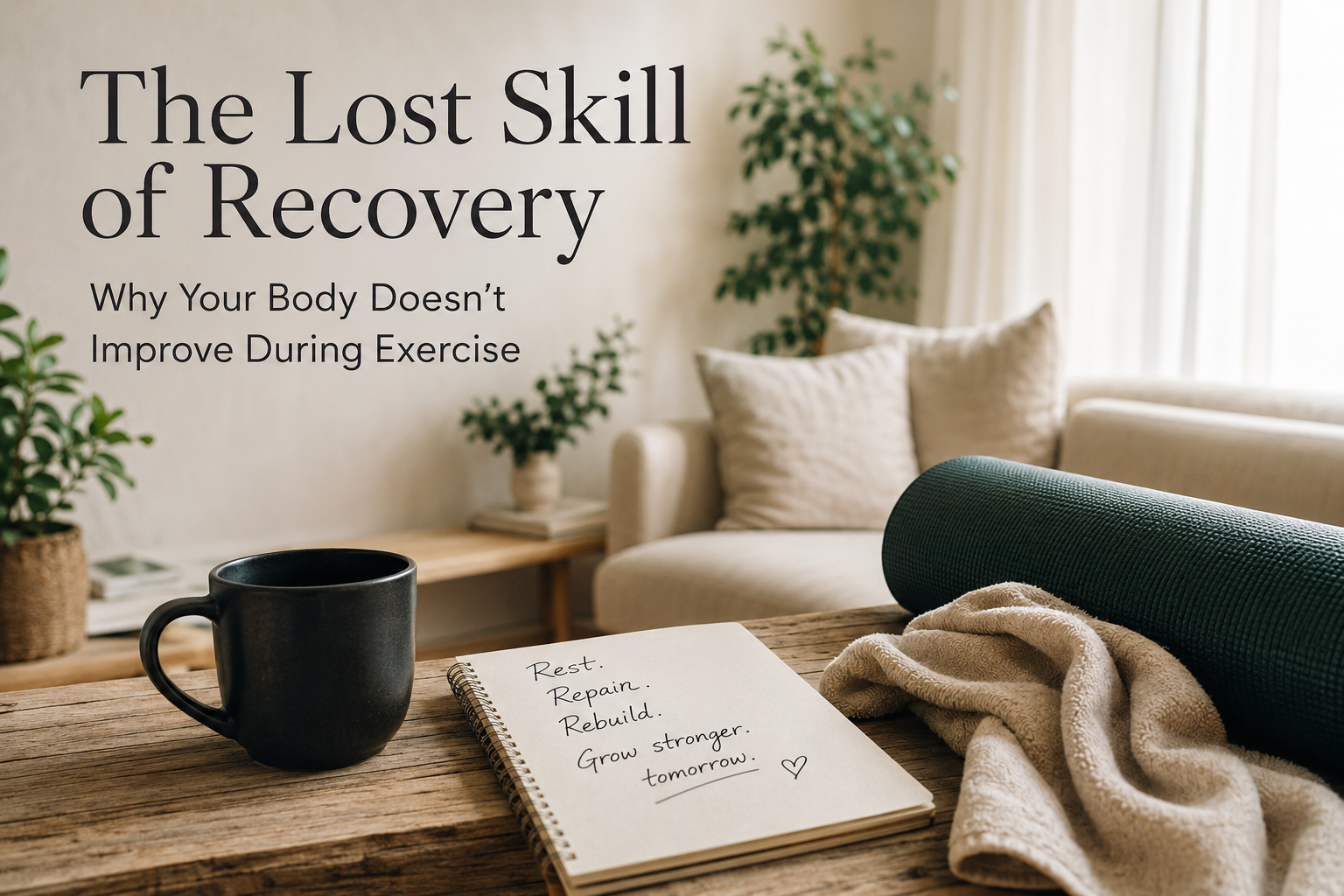
Your Body Doesn't Build During Movement. It Builds Afterwards.
Every time we move, we ask something of our body.
Perhaps we challenge a muscle that hasn't worked very hard in a while. Perhaps we ask the nervous system to coordinate a new movement. Maybe we practice standing on one leg, improve our posture, or simply move with more awareness than we did yesterday.
Those moments matter.
But not because they instantly make us stronger.
They matter because they give the body a reason to adapt.
Once the movement is over, an extraordinary process quietly begins. Tiny muscle fibres begin repairing themselves. Energy stores are replenished. Inflammation settles. Hormones help coordinate recovery. Cells communicate. Tissues rebuild.
None of this happens while you're exercising.
It happens afterwards.
In many ways, your workout is simply the invitation.
Recovery is the response.
Your Brain Is Working Overtime While You Think You're Resting
One of the things I find most fascinating is that muscles aren't the only part of you recovering.
Your brain is busy too.
Every movement you practice creates information.
The nervous system is constantly asking questions.
Was that movement efficient?
Did I lose my balance?
Could I do that with less effort next time?
Should I change the way those muscles work together?
The remarkable thing is that your brain keeps working on those questions long after the session has ended.
It's one of the reasons people sometimes come back the following week saying,
"That's strange. Last time this exercise felt impossible. Today it feels easy."
Nothing magical happened overnight.
Their nervous system simply continued learning.
We often imagine learning as something that only happens while we're actively practicing.
The body knows better.
Modern Life Has Made Recovery Feel Unproductive
I sometimes wonder whether we've become uncomfortable with recovery.
Everything around us encourages productivity.
We measure success by how busy we are, how much we accomplish, how many boxes we tick before the day is over.
Rest can almost feel like giving up.
I've noticed this mindset follows people into movement as well.
If one workout is good, surely two must be better.
If thirty minutes helped, perhaps ninety minutes will help even more.
If we're not exhausted, maybe we didn't work hard enough.
But the body doesn't think that way.
The body doesn't reward effort alone.
It rewards adaptation.
Without enough recovery, fatigue begins arriving faster than progress. Movements become less precise. Balance becomes harder. Motivation quietly disappears. Sometimes people assume they're losing fitness when, in reality, they're simply carrying yesterday's fatigue into today's movement.
Recovery Is Something We Practice
One of the reasons I encourage mindfulness alongside movement is because recovery isn't simply the absence of activity.
It is an active process.
A good night's sleep.
A slow walk after dinner.
Taking a few moments to breathe before rushing into the next task.
Eating well enough to support healing.
Giving your nervous system opportunities to settle rather than constantly asking it to stay alert.
These choices rarely feel dramatic.
They don't usually earn compliments.
No one proudly tells their friends they had an excellent recovery day.
Yet over weeks and months, these quiet moments become some of the strongest foundations for better movement.
I've come to believe that recovery deserves just as much intention as exercise itself.
Because one simply cannot exist without the other.
Recovery Is the Quiet Partner of Progress
One of the greatest lessons movement has taught me is that our bodies are remarkably patient.
They are not keeping score.
They are not asking us to work harder every single day.
They're simply asking for the opportunity to adapt.
Sometimes that means challenging ourselves.
Sometimes it means allowing ourselves to recover.
The wisdom lies in knowing the difference.
Here's My Final Tip
The next time you finish exercising, don't ask yourself only whether you worked hard enough.
Ask yourself another question.
"What am I going to do over the next 24 hours to help my body make the most of everything I've just asked it to do?"
You may discover that tomorrow's strength depends just as much on tonight's recovery as it does on today's movement.
Mantra:Recovery isn't the pause in progress. It is where progress quietly takes shape.
With mindfulness,
Elena