
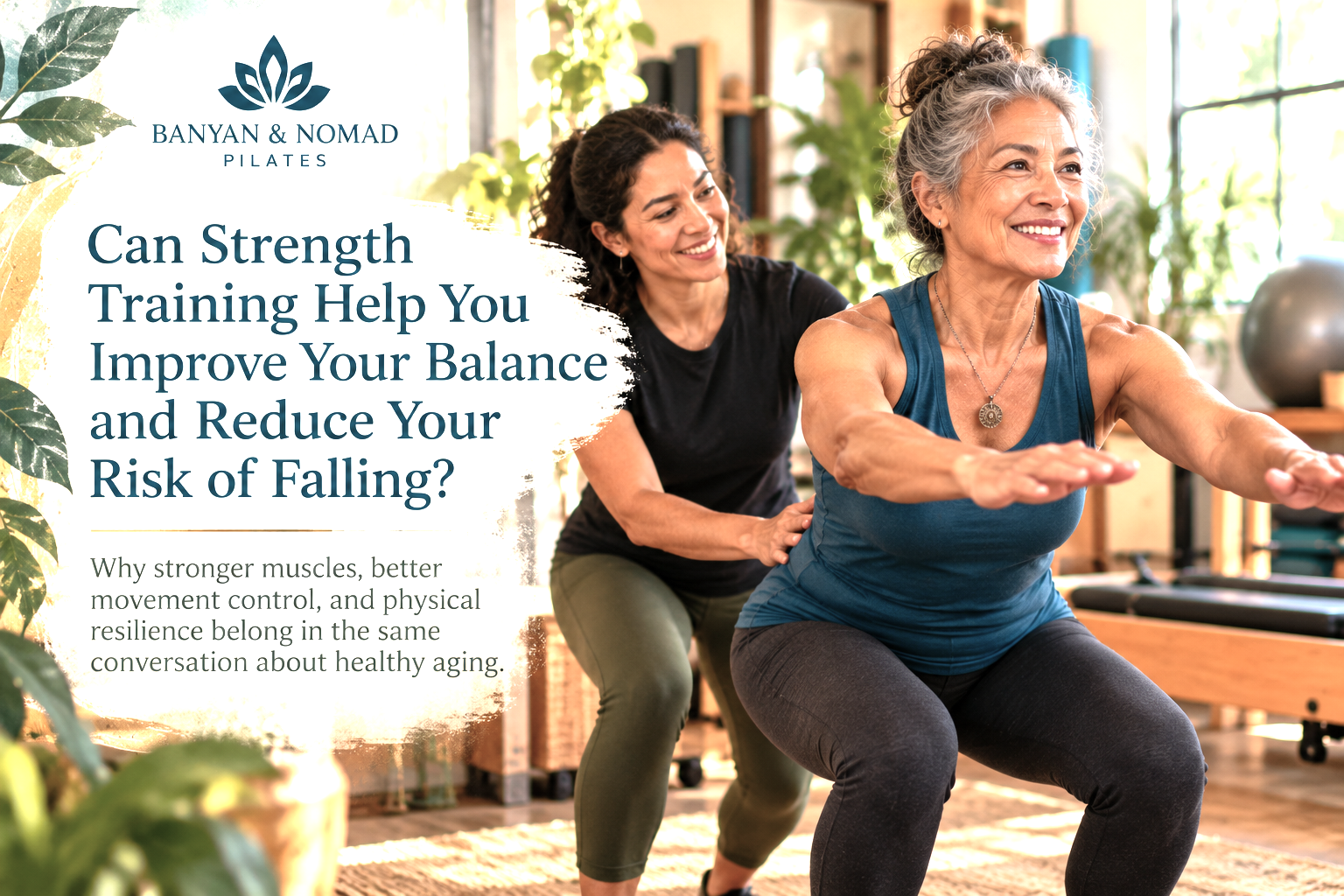
Can Strength Training Help You Improve Your Balance and Reduce Your Risk of Falling?
Why stronger muscles, better movement control, and physical resilience belong in the same conversation about healthy aging.
One of the questions I hear when discussing balance training is whether improving balance is enough, or whether people should also be working on their strength.
It's an excellent question, because balance and strength are closely connected, yet they aren't quite the same thing.
Someone may be able to stand steadily on one leg but struggle to rise from a low chair. Another person may have considerable muscular strength but find it difficult to change direction quickly or regain stability after an unexpected movement.
In both situations, something important is missing.
As an occupational therapist and Pilates instructor, I look at balance through the lens of everyday function. I'm interested in how people move, certainly, but I'm equally interested in what those movements allow them to do. Can they get out of a chair comfortably? Carry their groceries? Climb stairs? Navigate an unfamiliar environment? Respond when something unexpected happens?
And there's another question I believe deserves more attention: what happens if we do fall?
We spend considerable time discussing fall prevention, and rightly so. But maintaining strength, mobility, and physical resilience also matters when we think about recovering from physical challenges.
That's why I believe balance training and strength training should be viewed as complementary parts of a broader approach to movement, rather than competing methods.
What's the Difference Between Balance Training and Strength Training?
Balance training develops our ability to maintain or regain stability during movement and changes in position. Strength training improves our muscles' ability to produce force, helping us perform everyday activities such as standing, lifting, climbing, and carrying.
The distinction becomes clearer when we look at ordinary activities.
Imagine standing in your kitchen and reaching into a cupboard. You need enough strength to raise your arm and manage the object you're reaching for, but you also need balance to remain steady as your weight shifts.
Or consider getting out of a chair. Your leg and hip muscles provide much of the force needed to rise, while your balance system helps coordinate the transition from sitting to standing.
Neither ability works entirely independently of the other.
In Pilates, we frequently explore this relationship through controlled movements that require strength, coordination, and awareness of body position. But it's important to recognize that not every Pilates exercise provides the same progressive resistance stimulus as a dedicated strength-training program.
Different forms of exercise can serve different purposes.
I sometimes encourage people to think less about which type of exercise is best and more about which abilities they need to develop.
If someone has difficulty rising from a chair, leg strength may be an important part of the solution. If they struggle with turning or navigating changing surfaces, balance-specific practice may be particularly useful. Many people benefit from both.
The goal is not to choose one over the other. It's to understand how they work together.
Can Stronger Muscles Help Prevent Falls?
Strength training can contribute to fall prevention, particularly when combined with exercises that challenge balance and functional movement. Stronger muscles support activities such as standing, stepping, and climbing, but strength alone doesn't address every factor that contributes to falls.
Falls can happen for many reasons.
Sometimes the problem involves insufficient strength or difficulty controlling a movement. Other times, vision, medication effects, changes in sensation, environmental hazards, or medical conditions may play a role.
That's why a comprehensive approach is so important.
Think about stepping up onto a curb. Your legs need enough strength to lift and support your body, while your balance system helps you transfer weight from one foot to the other.
If the movement requires nearly all the strength you can produce, you may have less capacity available to respond when something unexpected happens.
Improving strength can make familiar physical tasks less demanding. It can also support the ability to control movement when sitting down, stepping, or changing position.
However, stronger muscles don't automatically mean better balance in every situation. Someone who exercises regularly in a gym may still benefit from practicing controlled turns, changes of direction, or other balance-specific tasks.
This is why exercise programs that combine balance challenges with functional strength work are particularly valuable for many older adults.
And it's also why I encourage people to look beyond a single exercise or measurement when evaluating their progress.
Why Is Leg Strength So Important as We Age?
Leg strength supports many of the movements that allow us to remain independent, including standing up, walking, climbing stairs, and getting in and out of vehicles. Maintaining strength becomes increasingly important as we age because muscle mass and physical capacity can decline without regular use and appropriate training.
One of the most revealing everyday movements is getting out of a chair.
We perform it so frequently that we rarely think about what it requires. Yet rising from a seated position involves coordinated effort from the hips, thighs, trunk, and feet.
The height of the chair matters. So does the firmness of the seat, whether armrests are available, and how tired we are.
Someone may rise comfortably from a dining chair but struggle with a low sofa. That doesn't necessarily indicate a completely different level of physical ability. The task itself has changed.
This is where my occupational therapy perspective becomes useful. Rather than focusing exclusively on whether someone can perform a movement, I want to understand the conditions under which they can perform it comfortably.
Perhaps they need to develop greater leg strength. Perhaps a higher seat or sturdy armrests would help. Often, both physical training and a practical adjustment are appropriate.
Stair climbing provides another example. Each step requires us to support and lift our body weight, coordinate our movements, and maintain stability while transferring weight between our legs.
When strength improves, these activities may require less relative effort.
And that can influence far more than exercise performance. It may affect whether someone feels comfortable visiting a friend's home, using public transportation, or exploring a neighborhood with hills and stairs.
These are the outcomes that make strength training meaningful.
Can Strength Training Help You Get Up After a Fall?
Strength training can support the physical abilities involved in getting up from the floor, particularly leg, arm, and trunk strength. However, getting up after a fall also requires mobility, coordination, appropriate technique, and an assessment of whether it is safe to move.
This is an aspect of balance that I believe we should discuss more openly.
Of course, we want to reduce the likelihood of falling. But we also need to consider what physical abilities might be useful if someone ends up on the floor.
Getting up from the floor is not simply a matter of having strong legs.
It may involve rolling, changing position, moving onto hands and knees, finding stable support, and coordinating several movements in sequence.
For some people, these movements are familiar. For others, they may be difficult because of limited mobility, joint pain, weakness, or uncertainty about how to proceed.
This is where individualized training can be valuable.
In an appropriate setting, a qualified professional can assess someone's ability to move between the floor and standing and, when suitable, help them develop the necessary skills gradually.
But I want to make an important distinction: being physically capable of getting up does not mean someone should automatically attempt it after a fall.
An injury may not be immediately obvious. Severe pain, a suspected fracture, head injury, dizziness, or an inability to bear weight are reasons to seek assistance rather than attempting to stand independently.
The objective isn't to teach people to ignore a fall and carry on.
It's to develop useful physical capacity while also understanding when to ask for help.
Does Strength Training Help Protect Against Fractures?
Appropriate resistance training can support bone health and help maintain muscle strength, both of which are relevant to fracture prevention. However, fracture risk also depends on bone density, fall circumstances, medical history, and other individual factors.
When people talk about falls, they often focus on the immediate loss of balance. But the consequences of a fall can be just as important.
A fall that causes a minor bruise in one person may result in a serious injury in another.
Bone health plays a significant role in this difference.
As we age, some people experience a reduction in bone density, increasing their vulnerability to fractures. Resistance training and appropriate weight-bearing activity can be important components of maintaining musculoskeletal health.
This doesn't mean that lifting weights makes someone immune to fractures. Nor does it mean that every type of resistance exercise is suitable for everyone.
Someone with osteoporosis, a history of fractures, or other medical considerations may need specific guidance about exercise selection, loading, and progression.
What matters is recognizing that healthy aging involves more than maintaining balance alone.
We also want to preserve the strength and physical capacity needed to move comfortably, manage daily tasks, and remain active.
I think this is a particularly important reason to encourage people to explore appropriate strength training as part of their longer-term movement routine.
Should You Start Strength Training Before or After a Balance Program?
Strength and balance training can often be developed together. There is no universal requirement to complete a balance program or achieve a particular level of confidence before beginning appropriate resistance exercise. The right starting point depends on individual abilities, health considerations, and goals.
This is a question I would love more people to ask.
Sometimes we imagine exercise as a sequence: first improve balance, then develop confidence, then begin strength training.
For certain individuals, a gradual progression may be necessary. Someone with significant instability or a complex medical history may need professional assessment and a carefully supervised starting point.
But for many people, balance and strength can be addressed alongside each other.
The exercises simply need to be appropriate.
Strength training doesn't have to begin with heavy weights or complicated gym equipment. Depending on the person, it may involve controlled sit-to-stand movements, resistance bands, machines, or other exercises that can be progressed safely.
Likewise, balance training doesn't have to involve standing unsupported on one leg. It can begin with controlled weight shifts, supported movements, and familiar functional tasks.
The important thing is to match the challenge to the person.
Within an eight-week balance program, the halfway point can be a useful opportunity to reflect on progress and identify additional needs.
Perhaps someone is becoming more comfortable with weight shifting but notices that climbing stairs remains difficult. Another participant may feel steadier during standing exercises but struggle with activities that require sustained muscular effort.
These observations can help guide the next stage of training.
Rather than assuming everyone needs the same progression, I prefer to encourage people to understand what their own daily activities are telling them.
How Can You Tell Whether Strength Training Might Help Your Everyday Balance?
You don't need to perform a difficult fitness test to begin thinking about your functional strength.
Instead, consider some familiar activities:
Do you find it increasingly difficult to rise from a low chair?
Do stairs require more effort than they used to?
Do you avoid carrying ordinary objects because they feel too demanding?
Do your legs become tired during activities that involve prolonged standing?
Do you find it difficult to lower yourself into a seat with control?
These observations don't diagnose weakness or identify its cause. Pain, joint limitations, cardiovascular concerns, neurological conditions, and other factors may contribute.
But they can provide useful starting points for a conversation with a qualified professional.
As an occupational therapist, I find these everyday examples particularly meaningful because they connect physical abilities to actual participation.
Someone may not be especially interested in increasing the amount of weight they can lift. They may, however, be very interested in carrying their groceries, getting up from the sofa comfortably, or visiting a place that involves several flights of stairs.
Those goals give strength training a purpose.
Balance and Strength Are Part of a Bigger Picture
I don't believe any single exercise method should claim to provide everything a person needs.
Pilates has tremendous value in developing movement awareness, coordination, control, and strength. Balance-specific training helps us work on stability and our responses to changing movement demands. Progressive resistance training can provide additional benefits for muscular strength and physical function.
Walking, appropriate aerobic activity, mobility work, and other forms of exercise also have their place.
The combination will look different from person to person.
My goal when working with someone isn't to make them dependent on one particular method or program. It's to help them understand their movement, develop useful skills, and feel better equipped to make decisions about their continued physical well-being.
An eight-week balance program can be an excellent beginning. It provides structure, opportunities to practice, and a chance to become more aware of how movement affects everyday activities.
But it doesn't have to be the end of the journey.
If the program helps someone recognize that additional strength training would be beneficial, I consider that a positive outcome.
If it encourages them to explore another activity, seek professional guidance, or become more consistent with movement, that's valuable too.
Ultimately, balance training is about much more than preventing a wobble or holding a position.
It's about maintaining the physical capacity, awareness, and confidence to continue participating in life.
And strength is an important part of that picture.
With mindfulness,
Elena