
Osteoporosis affects millions of Americans, and women carry a much greater share of that burden. According to the Centers for Disease Control and Prevention (CDC), 12.6% of U.S. adults aged 50 and older had osteoporosis in the 2017–2018 national health survey. Among women, the figure was 19.6%, compared with just 4.4% of men. The same survey found that more than half of women over 50 had low bone mass, a condition that can precede osteoporosis.
The difference becomes even more noticeable with age. Among women aged 65 and older, approximately 27% had osteoporosis. One major reason is menopause. As estrogen levels decline, bone loss accelerates, particularly during the first several years after menopause. Women also tend to have smaller, thinner bones than men, leaving them more vulnerable to fractures as they age.
Osteoporosis develops when bones lose enough density and structural strength to become more fragile. It often progresses without obvious symptoms. Many people don't know they have it until a minor fall results in a broken wrist, hip, or vertebra.
A diagnosis can understandably change how someone feels about exercise. Movements that once seemed perfectly ordinary may suddenly feel risky. Pilates, with its emphasis on controlled movement, strength, and body awareness, often seems like a sensible option. But is it actually helpful for osteoporosis?
The short answer is yes, with some important considerations. Pilates can improve several physical abilities that matter when living with osteoporosis, although it cannot replace the resistance and weight-bearing exercise needed for a comprehensive bone-health program.
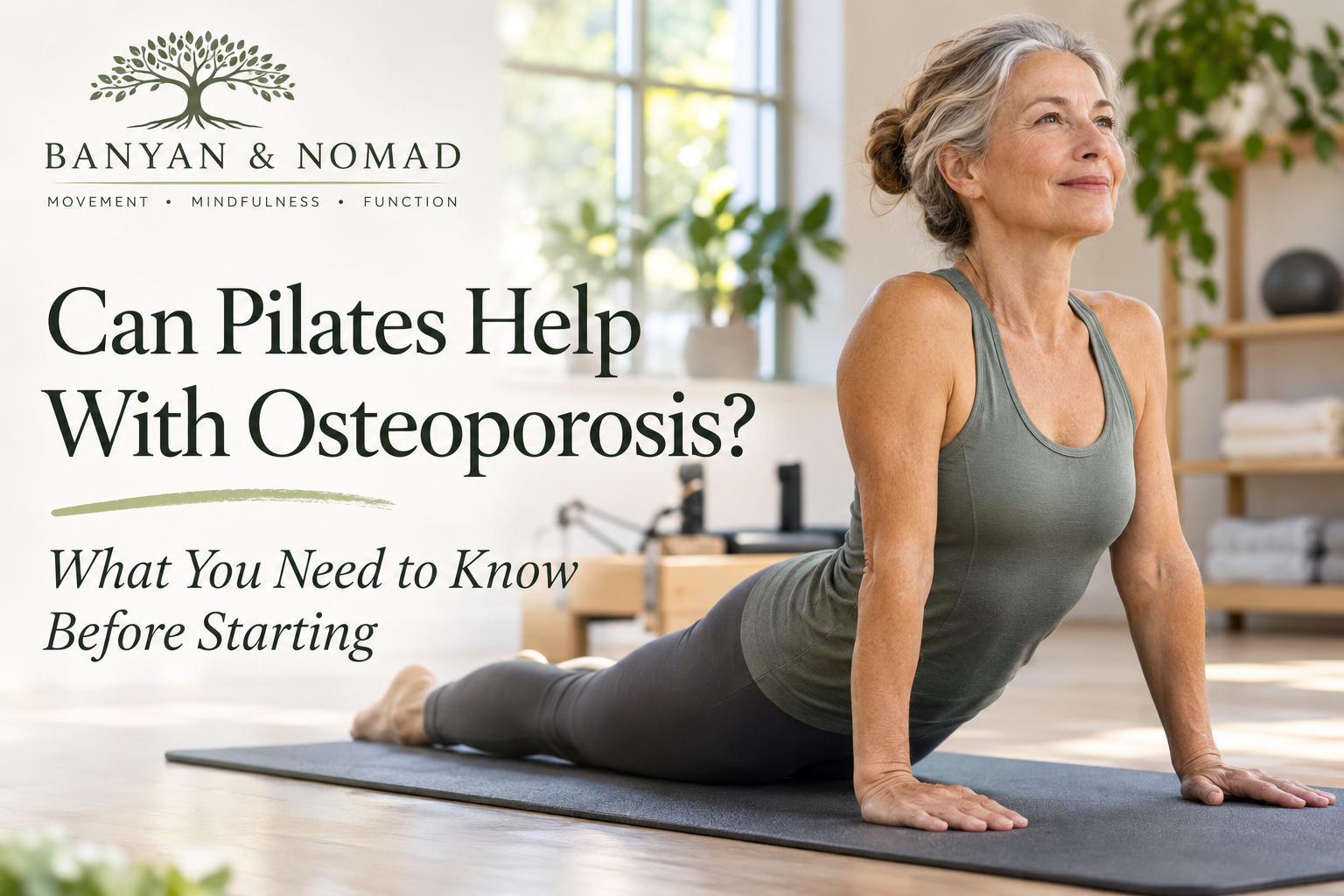
Can You Safely Practice Pilates If You Have Osteoporosis?
Yes. Most people with osteoporosis can practice Pilates safely when exercises are selected and modified according to their bone health, fracture history, and physical abilities. Having osteoporosis does not automatically mean giving up exercise or avoiding movement.
In fact, becoming less active can create additional problems. Muscles become weaker, balance may deteriorate, and everyday activities can start feeling more difficult. These changes can increase the likelihood of falling, which is particularly concerning when bones are already fragile.
What matters is understanding that not every Pilates exercise is appropriate for every person.
A traditional class might include repeated spinal curling, deep forward bends, or movements that place considerable pressure on the vertebrae. These exercises may need to be modified, especially for someone who has experienced a spinal compression fracture.
I encourage people to think about exercise in terms of what their bodies need rather than what they have been told they can no longer do. The goal is to remain active while making informed decisions about how to move.
Does Pilates Actually Improve Bone Density?
Pilates can improve muscle strength, posture, balance, and physical function, but evidence that it substantially increases bone mineral density is limited. It is best considered one part of a broader exercise program for osteoporosis rather than a stand-alone treatment.
Bone is living tissue. It responds to mechanical demands, which is why appropriately prescribed resistance training and weight-bearing activities are important for maintaining bone strength.
Walking, stair climbing, and progressive resistance exercises can all contribute to a bone-health program, although their effects differ. Walking alone, for example, generally provides less stimulus for increasing bone density than appropriately challenging resistance training.
Pilates contributes in other valuable ways. Strengthening the muscles around the hips, trunk, and shoulders can improve movement control and make daily activities easier. Better balance and coordination may also help reduce some of the factors associated with falls.
This distinction matters. An exercise doesn't have to increase bone density to be worthwhile. For someone with osteoporosis, improving the ability to stand steadily, change direction, or rise from a chair can have meaningful benefits.
Which Pilates Exercises Are Helpful for People With Osteoporosis?
Exercises that develop controlled strength, spinal support, hip stability, and balance are often useful starting points. The best choices depend on the individual's abilities and fracture risk.
Strengthening the Muscles That Support the Spine
The muscles along the back help maintain an upright posture and support the spine during everyday movement. Carefully selected spinal extension and postural endurance exercises can strengthen these muscles without requiring repeated forward curling.
This is particularly relevant because osteoporosis-related vertebral fractures can contribute to a more rounded upper back, discomfort, and changes in balance.
Improving Hip and Leg Strength
The hips and legs do a remarkable amount of work throughout the day. Standing up from a chair, climbing stairs, stepping into a bathtub, and getting out of a car all depend on adequate lower-body strength.
Modified Pilates exercises that strengthen the gluteal muscles, hips, and legs can support these activities. Depending on the person, exercises might be performed standing, lying on the side, or using equipment that provides appropriate support.
Developing Balance and Coordination
Balance is not something we use only when standing on one leg. We rely on it whenever we turn, reach, step over an obstacle, or adjust our position.
Pilates encourages attention to alignment, weight distribution, and controlled movement. These are useful skills, particularly when combined with balance exercises that progressively challenge stability in a safe environment.
Which Pilates Movements Should Be Modified or Avoided?
People with osteoporosis, particularly those at increased risk of spinal fractures, should be cautious with repeated, forceful, loaded, or extreme forward bending and twisting of the spine. Some familiar Pilates exercises fall into these categories.
Traditional movements such as the Roll-Up, Roll-Over, and certain curl-up variations involve substantial spinal flexion. Other exercises combine bending with rotation or place the spine under load while it is rounded.
These movements are not necessarily dangerous for everyone, but they may create unnecessary risk for someone with fragile vertebrae.
The Royal Osteoporosis Society recommends adapting exercises that involve excessive spinal flexion, especially when movements are sudden, repetitive, or performed against resistance.
One useful alternative is learning to bend from the hips while maintaining a comfortable, supported spinal position. This movement pattern, often called a hip hinge, is relevant far beyond the Pilates studio.
Think about picking up a laundry basket, loading the dishwasher, or reaching into a low cupboard. Learning how to distribute the work through the hips and legs can help reduce unnecessary strain on the back.
I also want to emphasize that bending and turning are normal parts of life. We shouldn't become afraid of every movement involving the spine. The important distinction is between comfortable, controlled movement and positions that place excessive stress on vulnerable bones.
Is Reformer Pilates Safer Than Mat Pilates for Osteoporosis?
Neither reformer nor mat Pilates is automatically safer for someone with osteoporosis. Safety depends more on the exercises, the amount and direction of resistance, the person's fracture risk, and the instructor's ability to make appropriate modifications.
A reformer can offer useful support and adjustable resistance. For some people, this makes certain strengthening exercises more accessible.
However, the reformer also allows exercises that involve deep spinal flexion, substantial resistance, or positions that may be inappropriate for someone with osteoporosis.
Mat Pilates presents similar considerations. Some exercises are easy to adapt using pillows, cushions, or changes in position, while others may be difficult for someone who struggles to get down to the floor or return to standing.
I would pay more attention to the instructor's experience working with osteoporosis than to the equipment being used.
A good instructor should be comfortable asking about your medical history, explaining modifications, and offering alternatives without making you feel that you're somehow doing a lesser version of Pilates.
Can Pilates Help Prevent Falls and Fractures?
Pilates may improve balance, strength, and physical function, all of which are relevant to fall prevention. However, direct evidence that Pilates reduces fracture rates is limited.
Falls rarely happen because of one isolated weakness. They often involve several factors, including reduced leg strength, slower reactions, difficulty shifting weight, environmental hazards, or problems with vision and sensation.
A well-designed movement program can address some of these issues.
For example, improving hip strength may make stepping and changing direction easier. Practicing balance can help someone become more comfortable adjusting their weight. Better trunk control may support stability during reaching and turning.
Pilates can contribute to these improvements, but it shouldn't be the only fall-prevention strategy. People at increased risk may also benefit from specific balance training, strength exercises, a review of medications, and changes to their home environment.
The objective is not simply to perform an exercise correctly. It is to carry those improvements into everyday life.
Should You See a Physical or Occupational Therapist Before Starting Pilates?
A professional assessment is particularly valuable if you have experienced a fragility fracture, have significant osteoporosis, struggle with balance, or are uncertain which movements are safe. A physical therapist can help assess movement and prescribe appropriate exercise, while an occupational therapist can address how physical limitations affect daily activities.
From an occupational therapy perspective, I am interested in what happens outside an exercise session.
Can you reach into a cupboard comfortably? Carry groceries without straining your back? Get dressed, clean your home, or continue gardening without feeling that every movement might cause an injury?
These are practical concerns, and they deserve practical solutions.
Occupational therapy can help people adapt how they perform everyday activities, improve body mechanics, and identify environmental changes that make daily routines safer. Physical therapy can provide individualized strengthening, balance training, and rehabilitation, particularly following a fracture.
For someone living with osteoporosis, these approaches can complement Pilates by connecting movement skills with the activities that matter most.
How Often Should You Practice Pilates if You Have Osteoporosis?
Two or three appropriately modified Pilates sessions per week may be a reasonable starting point for some people, but there is no single Pilates schedule proven to be best for osteoporosis. Frequency should reflect your current fitness, medical history, recovery needs, and overall exercise program.
Research-based osteoporosis exercise recommendations generally include progressive resistance training at least twice weekly, regular balance training, and exercises that support spinal posture and endurance.
Pilates can contribute to some of these goals. However, it may need to be combined with other forms of exercise to provide sufficient loading for bone health.
Someone who has been inactive for several years may need to begin with short, manageable sessions and progress gradually. Someone who has practiced Pilates for a decade may already have good movement awareness but still need to modify particular exercises after an osteoporosis diagnosis.
There is no advantage in rushing the process. What matters is choosing activities that are appropriately challenging, sustainable, and safe for your circumstances.
Can You Start Pilates After an Osteoporosis Diagnosis?
Yes, and for many people, continuing to move is an important part of managing osteoporosis. The key is to begin with a clear understanding of your individual risks and to choose instruction that respects those needs.
An osteoporosis diagnosis can make people question movements they have performed comfortably for years. That uncertainty is understandable, especially after a fracture or a period of pain.
But avoiding movement altogether is rarely the answer.
Pilates can help you develop strength, coordination, posture, and confidence in how your body moves. It is not a cure for osteoporosis, and it does not replace medical treatment, nutritional support, or an appropriate bone-strengthening exercise program. It can, however, be a valuable part of maintaining physical function and independence.
At Banyan & Nomad, my approach is to help people understand their bodies and find ways to keep participating in the activities that matter to them. Sometimes that involves modifying an exercise. Sometimes it means changing how a daily task is performed. And sometimes it begins with recognizing that a diagnosis does not have to define everything your body is capable of doing.
With mindfulness,
Elena
References and Further Reading
CDC, Osteoporosis or Low Bone Mass in Older Adults: United States, 2017–2018
https://www.cdc.gov/nchs/products/databriefs/db405.htmU.S. Office on Women's Health, Osteoporosis
https://womenshealth.gov/a-z-topics/osteoporosisBone Health & Osteoporosis Foundation, What Women Need to Know
https://www.bonehealthandosteoporosis.org/preventing-fractures/general-facts/what-women-need-to-know/Royal Osteoporosis Society, Pilates and Osteoporosis
https://theros.org.uk/information-and-support/exercise/pilates-and-osteoporosis/Royal Osteoporosis Society, How to Exercise Safely for Bones
https://theros.org.uk/information-and-support/exercise/how-to-exercise-safely-for-bones/Strong, Steady and Straight: UK Consensus Statement on Physical Activity and Exercise for Osteoporosis
https://bjsm.bmj.com/content/56/15/837Too Fit To Fracture: Exercise Recommendations for Individuals With Osteoporosis or Osteoporotic Vertebral Fracture
https://pmc.ncbi.nlm.nih.gov/articles/PMC5112023/Too Fit To Fracture: Outcomes of a Delphi Consensus Process
https://pubmed.ncbi.nlm.nih.gov/25510579/U.S. Preventive Services Task Force, Osteoporosis to Prevent Fractures: Screening
https://www.uspreventiveservicestaskforce.org/uspstf/document/RecommendationStatementFinal/osteoporosis-screening